Editorial staff

- What Is a Bot for Crypto Trading?
- What Are the Main Types of Bot Strategies?
- Rule-Based Bots vs. AI Trading Bots: What's the Real Difference?
- Why Telegram Signal Groups Are Not a Strategy
- The Best Bots for Crypto Trading, Reviewed
- How to Set Up a Crypto Trading Bot: A Step-by-Step Guide
- Key Features to Look for in a Crypto Trading Bot
- Risks and Limitations of Automated Crypto Trading
- Which Crypto Trading Bot Is Best for Beginners?
- Frequently Asked Questions
- Is there a bot specifically for Bitcoin trading?
- What separates SaintQuant from the other bots on this list?
- Conclusion: The Right Bot for Crypto Trading Depends on Your Goals
A bot for crypto trading removes the latency, the emotion, and the round-the-clock screen time. But not all bots are built the same. Some run simple if-then rules. Others deploy the same institutional-grade quantitative strategies used by hedge funds. Choosing the wrong one doesn't just waste your subscription fee — it can cost you real capital.
This guide breaks down the best trading bots for crypto in 2026: what they are, how they work, who they suit, what they cost, and — crucially — what the marketing doesn't always tell you.
What Is a Bot for Crypto Trading?
A crypto trading bot is software that connects to a cryptocurrency exchange and automatically executes buy, sell, and rebalance orders based on predefined rules, signals, or AI-driven analysis. It monitors markets continuously, reacts in milliseconds, and does so without emotion.
Algorithmic trading has been used in traditional financial markets since the 1980s, initially to automate index rebalancing and arbitrage. Crypto markets — which operate 24 hours a day, seven days a week, and are significantly more volatile than equities — are an even more natural home for automated strategies. A human trader cannot effectively monitor BTC/USD at 3am on a Sunday. A bot can, and will execute without hesitation.
That said, a bot does not eliminate risk. It automates a strategy, which may generate returns or losses depending on market conditions and configuration. The edge a bot provides is speed, consistency, and emotional discipline — not a guarantee of profit.
What Are the Main Types of Bot Strategies?
Understanding the strategy your bot runs matters more than any feature list. The type of strategy determines when it performs, when it underperforms, and what market conditions it requires.
Grid Trading places a series of buy and sell orders at regular price intervals above and below the current market price. When price oscillates in a range, the bot profits from each swing. Grid bots thrive in sideways, range-bound markets and underperform in strong directional trends.
Dollar-Cost Averaging (DCA) systematically purchases an asset at regular intervals regardless of price, reducing the average cost basis over time. DCA bots suit long-term accumulation strategies and work well during extended downtrends — though they require patience and sufficient capital to hold through volatility.
Arbitrage exploits price differences for the same asset across different exchanges or trading pairs simultaneously. Margins are thin, execution must be fast, and the strategy requires sufficient capital across multiple venues. Arbitrage is market-neutral by design — it doesn't require a directional view on where price is heading.
Trend-Following uses technical indicators — moving averages, momentum signals — to identify directional moves and enter positions aligned with the trend. These bots perform well in strong bull or bear markets and typically underperform in choppy sideways conditions.
Market-Neutral Strategies aim to generate returns regardless of overall market direction by simultaneously managing long and short exposures in related assets. These approaches, common at institutional quantitative funds, are designed to reduce exposure to broader market swings — meaning they can generate returns even when the overall market is flat or declining.
What separates platforms like SaintQuant from simpler bot tools is the ability to deploy multiple strategy types simultaneously, letting AI determine which approach is most appropriate for prevailing conditions — rather than forcing a single strategy regardless of what the market is doing.
Rule-Based Bots vs. AI Trading Bots: What's the Real Difference?
This distinction matters more than most articles acknowledge.
A rule-based bot executes a fixed set of instructions you define: "buy when RSI drops below 30, sell when it crosses above 70." It cannot deviate from those rules. If market conditions change — if a historically reliable indicator stops working in a trending market — the bot will continue executing the old rules regardless.
A true AI trading bot uses machine learning models trained on historical market data to identify patterns, adjust strategy parameters, and — in the most sophisticated implementations — select entirely different strategy frameworks depending on observed conditions. It adapts to regime changes that would break a static rule-based system.
The important caveat: even AI bots are trained on past data. A sufficiently novel market event — a black swan shock, a regulatory announcement, a liquidity crisis — can challenge any automated system. The AI advantage is consistency, speed, and adaptability within normal market regimes, not prediction of the unpredictable.
Why Telegram Signal Groups Are Not a Strategy
If you've spent time in crypto communities, you've encountered Telegram signal groups — channels where anonymous "analyst" posts buy and sell calls, sometimes charging a monthly fee for the privilege.
The core problem isn't that signals are always wrong. Some signal providers have genuine edge. The structural problem is that you have no visibility into the methodology, no access to historical performance data, no risk management framework, and no protection if the provider disappears tomorrow.
A properly configured bot for crypto trading solves each of these problems. The strategy logic is transparent and auditable. Performance is tracked and visible. Risk parameters — stop-losses, position size limits, maximum drawdown thresholds — are enforced automatically, not left to your manual discipline at 2am during a red candle. The migration from signals to automated trading is one of the most consequential upgrades a retail crypto trader can make.crypto trade
Quick Comparison: Best Bots for Crypto Trading at a Glance
| Platform | Best For | Price | Strategy Type | Exchange Support | Skill Level | |
| SaintQuant | AI quant strategies, passive income | $99 Free Trial & Subscription tiers | Market-neutral, arbitrage, trend-following | Major CEXs | Beginner–Advanced | |
| Pionex | Free built-in bots | Free (0.05% fee) | Grid, DCA, arbitrage | Built-in exchange | Beginner | |
| 3Commas | Feature-rich automation | Free–$59/mo | DCA, grid, signals | 20+ exchanges | Beginner–Advanced | |
| CryptoHopper | Customisable AI strategies | Free–$107.50/mo | Custom + AI strategy selector | 16 exchanges | Beginner–Advanced | |
| Coinrule | No-code rule building | Free–$749/mo | Rule-based (IFTTT logic) | 10+ exchanges | Beginner | |
| Altrady | Portfolio management + bots | $31–$100/mo | Automated strategies | 15+ exchanges | Beginner–Advanced | |
| TradeSanta | Easy setup, low cost | $25–$90/mo | Grid, DCA | 9 exchanges | Beginner | |
| Gunbot | Privacy, advanced customisation | $199–$499 (lifetime) | Fully custom | 100+ exchanges | Advanced | |
| Phemex | Bot marketplace, copy trading | Free (0.01–0.06% fee) | Copy-trade, futures bots | Built-in exchange | Beginner |
The Best Bots for Crypto Trading, Reviewed
Best for AI-Powered Quantitative Strategies: SaintQuant
For traders who want institutional-calibre automation without the institutional price tag, SaintQuant is the most compelling platform available to retail users in 2026. Built in Australia and trusted by 150,000+ users globally, SaintQuant runs 18+ live quantitative strategies — including market-neutral, arbitrage, and trend-following approaches — all powered by AI and machine learning models that continuously adapt to market conditions.
What separates SaintQuant from rule-based competitors is architectural depth. Most bots execute a fixed set of instructions you define upfront. SaintQuant's AI analyses real-time market data, cross-references multiple strategy signals, and selects the optimal approach for prevailing conditions — 24/7, without manual intervention. The platform's institutional-grade risk management enforces position limits and drawdown controls that most retail bots leave entirely to the user to configure.
In practice, what this looks like is: you register, claim your trial funds, and use SaintQuant's one-click strategy configuration to activate a live quantitative strategy immediately — no API setup, no coding, no exchange security configuration required. From there, you can make a deposit, upgrade to a more advanced plan, and unlock greater passive income potential. SaintQuant surfaces performance data transparently through a live dashboard showing ROI metrics and strategy-by-strategy breakdowns — so you always know exactly what the algorithms are doing with your capital.
Key features: 18+ live strategies | AI + ML execution | One-click strategy activation | Institutional risk management | 24/7 automated trading | Transparent performance dashboard
Best for: Passive income seekers, traders exiting Telegram signal groups, anyone who wants genuine automation without technical overhead
Skill level: Beginner to Advanced
Best Free Bot for Crypto Trading: Pionex
Pionex takes a fundamentally different approach: it's a crypto exchange that bundles 16 trading bots for free. No monthly subscription. No paywalled strategies. You only pay Pionex's standard 0.05% trading fee when trades execute.
The bot library is broader than you'd expect from a zero-cost offering. Grid bot, infinity grid, DCA bot, arbitrage bot, leveraged grid, and rebalancing bot are all included. The AI Strategy feature recommends grid parameters for beginners — you don't have to configure anything from scratch.
The key limitation is that Pionex is its own closed exchange, so your funds stay on Pionex's platform. Users who want to run bots across Binance, Coinbase, or Kraken will need a different solution.
Key features: 16 free built-in bots | Demo mode | AI parameter recommendations | 0.05% trading fee only
Best for: Absolute beginners who want to test automated trading at zero upfront cost
Skill level: Beginner
Best AI Trading Bot for Strategy Customisation: CryptoHopper
CryptoHopper earns its reputation as the most customisable AI trading bot on the market. The platform's AI Strategy Designer automatically backtests hundreds of strategy combinations and deploys whichever performs best under current conditions — without you needing to decide.
You can build your own strategies from scratch, access a marketplace of signals from professional traders, and use paper trading to validate approaches before risking real capital. The free tier offers unlimited copy bots that mirror successful traders' strategies — genuinely useful even at zero cost. The tradeoff is depth: the sheer range of options can overwhelm true beginners, so plan for 30–60 minutes of initial setup time.
Key features: AI strategy optimisation | Backtesting | Paper trading | Signal marketplace | Trailing stop-loss
Pricing: Free | Explorer $24.16/mo | Adventurer $57.50/mo | Hero $107.50/mo
Exchange support: 16 exchanges including Binance, Coinbase, KuCoin, ByBit, Kraken
Skill level: Beginner to Advanced
Best for Feature-Rich Automation: 3Commas
3Commas serves more than 100,000 active traders and is the go-to platform for users who want advanced order types that most native crypto exchanges don't offer. The SmartTrade terminal enables simultaneous take-profit and stop-loss on the same position — a discipline tool that solo traders frequently overlook.
The DCA bot is particularly well-regarded: it systematically buys into a position during price dips, averaging down your cost basis while managing risk through configurable safety orders. TradingView integration means you can build signal-triggered strategies without writing a single line of code.
Key features: Trailing stop-loss | DCA bot | TradingView signal integration | SmartTrade terminal | Mobile app
Pricing: Free | $37/mo | $59/mo
Exchange support: 20+ exchanges including Binance, Coinbase, Kraken, Gemini, Bitfinex
Skill level: Beginner to Advanced
Best Bitcoin Bot for Beginners (No-Code): Coinrule
If you've never used a bot before, Coinrule is the lowest-friction entry point for building your own automated rules. The platform's drag-and-drop interface uses IFTTT-style logic ("If Bitcoin drops 5%, buy $100 worth") that requires zero coding ability. The 2026 addition of CoinruleGPT — an AI assistant that writes trading rules in plain English — lowers the barrier further.
The free plan includes two live rules and access to one exchange, which is sufficient for testing. Advanced traders will hit the ceiling quickly, but for first-timers the educational resources and demo exchange make the learning curve genuinely manageable.
Key features: Drag-and-drop rule builder | CoinruleGPT AI assistant | 150+ strategy templates | Demo exchange | Beginner tutorial section
Pricing: Free | Investor $29.99/mo | Trader $59.99/mo | Fund $749/mo
Exchange support: 10+ exchanges including Binance, Coinbase, Kraken, Bitpanda
Skill level: Beginner to Advanced
Best for Automatic Portfolio Management: Altrady
Altrady sits at the intersection of trading bot and portfolio management platform. Beyond automated strategies, it offers technical analysis tools, moving stop-loss, trade journaling, and real-time market data — all in a single interface. The 30-day money-back guarantee makes it one of the lower-risk paid platforms to trial.
Key features: Trading bots + portfolio management | Moving stop-loss | Trade journaling | Advanced analytics | 30-day money-back guarantee
Pricing: Basic $31/mo | Essential $55/mo | Premium $100/mo
Exchange support: 15+ exchanges including Coinbase, Binance, MEXC
Skill level: Beginner to Advanced
Best Budget Bot for Easy Setup: TradeSanta
For traders who want to start automating without a steep learning curve or a large monthly bill, TradeSanta delivers a clean, template-driven experience at $25/month entry. Pre-built strategy templates mean you can have a grid or DCA bot running within 20 minutes of signup. 24/7 live support is included on all plans — rare at this price point.
Key features: Strategy templates | Beginner-friendly interface | 24/7 support | 3-day free trial
Pricing: Basic $25/mo | Advanced $45/mo | Maximum $90/mo
Exchange support: Binance, OKX, ByBit, Coinbase Advanced, Kraken, HTX, others
Skill level: Beginner
Best for Advanced Privacy and Customisation: Gunbot
Gunbot is self-hosted, not cloud-based — which means it runs on your own server and your trade logic never touches a third-party platform. That privacy advantage comes with a requirement: you need to be comfortable running a server continuously. This is squarely an advanced-user tool. The one-time lifetime licence ($199–$499) offers a long-term cost saving for high-frequency traders tired of monthly fees.
Key features: Server-based (full privacy) | 100+ exchange support | Highly customisable | Active community for strategy sharing
Pricing: $199–$499 (lifetime licence)
Exchange support: 100+ exchanges
Skill level: Advanced
How to Set Up a Crypto Trading Bot: A Step-by-Step Guide
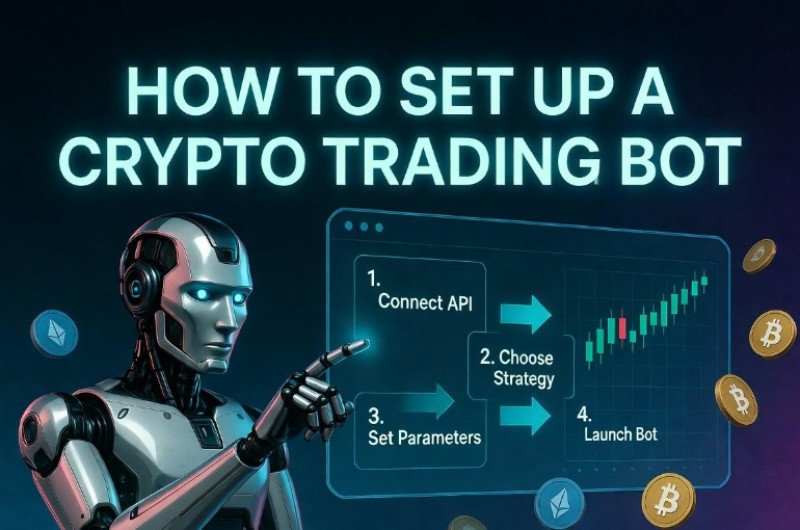
Using SaintQuant as our demonstration, here is what getting started with a crypto trading bot actually looks like in 2026 — no coding, no API configuration, no exchange security management required.
Step 1 — Register your account. Visit SaintQuant's website and create a free account. Signup takes a few minutes and requires only basic account details.
Step 2 — Claim your trial funds. New users receive trial funds to explore the platform before committing any capital. This gives you a live look at how the strategies perform without any initial financial risk.
Step 3 — Activate a strategy with one click. SaintQuant's interface presents its 18+ live quantitative strategies with clear descriptions of each strategy's risk profile and historical performance. Select the strategy that matches your risk tolerance and click to activate. There is no exchange API to configure, no code to write, and no security settings to manage — the platform handles the entire technical infrastructure.
Step 4 — Monitor your returns. The SaintQuant dashboard displays live ROI metrics, strategy-by-strategy performance breakdowns, and position activity in real time. You always know what the algorithms are doing and how your capital is performing.
Step 5 — Make a deposit and upgrade your plan. Once you're satisfied with the platform's performance, make a real deposit and upgrade to a more advanced plan to unlock additional strategies, higher capital limits, and greater passive income potential.
That is the complete flow. SaintQuant is built so that the complexity of quantitative trading — strategy selection, execution, risk management, and exchange connectivity — is handled entirely on the platform's side. Your role is to select your risk level and monitor the results.
Key Features to Look for in a Crypto Trading Bot
Ease of Activation
The best platforms in 2026 allow you to go from registration to a live strategy in minutes — not hours. SaintQuant's one-click activation is the clearest example of this. Look for platforms where strategy setup does not require technical prerequisites.
Strategy Diversity
A single-strategy bot is vulnerable to changing market conditions. Platforms that offer multiple strategy types — or that use AI to switch between them dynamically — are significantly more resilient across different market regimes.
Risk Management Controls
The best bot platforms enforce risk at the platform level: position size limits, stop-losses, maximum drawdown thresholds, and emergency pause mechanisms. If a platform leaves all risk decisions entirely to the user, that places significant responsibility on individual discipline — which is one of the things automation is supposed to remove.
Transparency and Performance Reporting
Can you see exactly what the bot is doing, and why? Look for live trade logs, strategy logic explanations, and performance metrics in a format you can actually read and interpret without a finance degree.
Exchange Compatibility
Confirm the bot supports your preferred crypto exchanges before subscribing. Most major platforms support Binance, Coinbase, Kraken, and ByBit. On fully managed platforms like SaintQuant, exchange connectivity is handled on the backend — users don't need to configure it directly.
Free Trial or Trial Funds
Reputable platforms let you evaluate performance before committing capital. SaintQuant provides trial funds for new users. Other platforms offer free tiers or time-limited trials. Be cautious of any platform that requires a full financial commitment before you can assess performance.
Support and Educational Resources
Strong customer support and a well-developed knowledge base matter — particularly for users new to automated trading. Look for platforms with responsive support channels, tutorial libraries, and active community forums.
Risks and Limitations of Automated Crypto Trading
Understanding what can go wrong is as important as knowing what can go right.
Market regime changes. A grid bot thriving in a sideways market can lose money quickly when a strong directional trend emerges. Strategy selection must align with market conditions — which is one reason multi-strategy AI platforms are generally more resilient than single-strategy bots.
Over-optimisation. Backtests are seductive. A strategy that looks outstanding against three years of historical Bitcoin data may have been specifically tuned to fit that particular price sequence — a problem called overfitting. Real-world performance frequently disappoints over-optimised backtests.
Exchange risk. Your funds sit on the exchange or platform, not in the bot itself. Exchange hacks, insolvencies, or regulatory shutdowns can affect your capital regardless of bot configuration. Using regulated, reputable platforms reduces but does not eliminate this risk.
Technical failure. Software bugs, connection interruptions, and unexpected platform downtime can cause a bot to miss trades or execute incorrectly. Monitor your bot regularly and set up activity alerts.
Human intervention at the wrong moment. One of the most common causes of bot underperformance is the user overriding the strategy in a moment of panic. If you've selected a strategy with defined risk parameters, allow it to operate within those parameters before intervening.
Which Crypto Trading Bot Is Best for Beginners?
The honest answer depends on what "beginner" means for you.
If you want to start immediately with zero setup, zero technical knowledge, and no API or exchange configuration: SaintQuant is the clearest answer. Simply register, claim your trial funds, select a strategy in one click, and the platform's AI handles everything else — strategy selection, execution, and risk management. There is no exchange connection to configure, no stop-loss parameters to set manually, and no code to write. For a beginner whose goal is passive income rather than becoming a trading technician, SaintQuant represents the most direct path from registration to live automated returns.
If you want free automation on a built-in exchange with minimal commitment: Pionex is the lowest-friction no-cost option. Its AI-recommended grid parameters mean you don't need to make many configuration decisions, but you are working within a narrower set of strategies on a single platform.
If you want to learn how automated strategies work by building your own rules: Coinrule is purpose-built for this. The drag-and-drop interface and CoinruleGPT make strategy construction genuinely accessible — and you'll come away with a much clearer understanding of how trading logic actually functions.
The most important distinction for a true beginner is this: SaintQuant asks you to choose your risk appetite — the platform handles the rest. Other platforms ask you to choose your strategy, configure your parameters, manage your risk settings, and connect your exchange. The former requires almost no trading knowledge to get started. The latter requires a meaningful amount — and exposes the user to configuration errors that can affect performance.
If your goal is passive income without becoming a full-time trading technician, SaintQuant is the most appropriate starting point. If your goal is to understand and build automated strategies yourself, Coinrule or CryptoHopper will serve you better.
Beginner Decision Framework: Which Bot Is Right for You?
| I want to… | Best option |
| Start earning immediately with minimal setup | SaintQuant |
| Try bots for free with zero monthly cost | Pionex |
| Build my own rules without coding | Coinrule |
| Copy strategies from proven traders | CryptoHopper (free tier) |
| Run advanced multi-exchange DCA strategies | 3Commas |
| Maximise privacy and full customisation | Gunbot |
| Manage my portfolio and automate simultaneously | Altrady |
Frequently Asked Questions
What is SaintQuant and how does it work?
SaintQuant is an Australian AI-powered crypto trading platform trusted by 150,000+ users globally. It runs 18+ live quantitative strategies — including market-neutral, arbitrage, and trend-following approaches — powered by AI and machine learning that continuously adapts to market conditions. Users register, claim trial funds, activate a strategy in one click, and the platform handles execution, risk management, and performance reporting automatically. No API configuration or coding is required.
Is automated crypto trading legal?
Yes, in the vast majority of jurisdictions — including Australia, the US, the UK, and the EU. Using bots to trade on exchanges you have authorised access to is entirely legal. Where it becomes problematic is market manipulation such as wash trading or spoofing, which is illegal regardless of whether a human or a bot executes it.
Can I lose money using a crypto trading bot?
Yes. A bot does not eliminate risk — it automates a strategy, which may generate returns or losses depending on market conditions and configuration. Platforms like SaintQuant include institutional-grade risk management that enforces position limits and drawdown controls automatically, which significantly reduces the risk of catastrophic loss compared to unmanaged manual trading.
What is the best free crypto trading bot?
Pionex offers the most capable free bot suite for beginners — 16 bots with no subscription fee. CryptoHopper's free tier is worth considering for access to the strategy marketplace. SaintQuant offers new users trial funds to evaluate live performance before making any financial commitment, which is a meaningful alternative to a free plan.
Do I need to know how to code to use a crypto trading bot?
No. Platforms like SaintQuant, Pionex, Coinrule, 3Commas, and CryptoHopper are all designed for non-technical users. SaintQuant in particular requires no coding, no exchange API setup, and no technical configuration at all — the entire platform is built around one-click strategy activation.
How do crypto trading bots make money?
Bots profit by executing strategies designed to capture price differentials, momentum, or mean-reversion patterns — depending on the strategy type. The edge comes from frequency and consistency: executing a well-designed strategy repeatedly without the emotional errors that cause human traders to deviate from their plan. SaintQuant's multi-strategy AI approach adds a further layer by dynamically allocating to the strategy best suited to current market conditions.
Which crypto exchanges do trading bots work with?
Most major bots support Binance, Coinbase Advanced, Kraken, ByBit, and OKX. Exchange support varies by platform — always verify your preferred exchange is supported before subscribing. On SaintQuant, exchange connectivity is managed entirely by the platform on the backend, so users don't need to manage this directly.
Is there a bot specifically for Bitcoin trading?
Most bots support BTC trading pairs by default — it's the most liquid market on most exchanges. SaintQuant's quantitative strategies include Bitcoin exposure across multiple approaches. 3Commas and CryptoHopper also offer dedicated Bitcoin bot configurations.
How much capital do I need to start with SaintQuant?
SaintQuant provides trial funds for new users, so you can evaluate the platform before committing any capital of your own. Once you're ready to deposit, SaintQuant offers subscription tiers to match different capital levels and income goals. For other platforms running grid or DCA strategies, a minimum of $150–$500 is typically recommended for the bot to function meaningfully.
What separates SaintQuant from the other bots on this list?
Most platforms on this list are tools that require you to configure a strategy, manage your risk settings, connect your exchange, and make ongoing decisions about which approach to run. SaintQuant is a managed AI trading system — the platform selects strategies, executes trades, and enforces risk controls autonomously. The user experience is fundamentally different: less configuration, more transparency, and no requirement to have existing trading expertise to begin generating returns.
Conclusion: The Right Bot for Crypto Trading Depends on Your Goals
The best bot for crypto trading in 2026 isn't the one with the most features — it's the one that matches your goals, your risk tolerance, and how much involvement you actually want in day-to-day management.
For fully managed, AI-driven passive income backed by institutional-grade quantitative strategies: SaintQuant is the most complete option available to retail traders, trusted by 150,000+ users globally. For free entry-level automation: Pionex. For customisable AI strategies: CryptoHopper. For disciplined DCA and multi-exchange execution: 3Commas.
Whatever platform you choose, apply the same discipline you'd want from your bot: start with a modest allocation, define your risk parameters upfront, and give the strategy enough time to demonstrate real-world performance before drawing conclusions.
Ready to experience AI-powered quantitative trading for yourself? Start your free trial on SaintQuant — claim your trial funds, activate a strategy in one click, and see the difference between rule-based bots and true institutional-grade automation.
 Editorial staff