Marina Lyubimova

Retail activity in Europe posted a modest monthly decline in February, yet the broader structure suggests stability rather than weakness. The latest Eurostat data aligns with a chart that shows retail volumes holding near recent highs after a multi-year recovery phase.
A Minor EU Retail Pullback Within a Stable Range
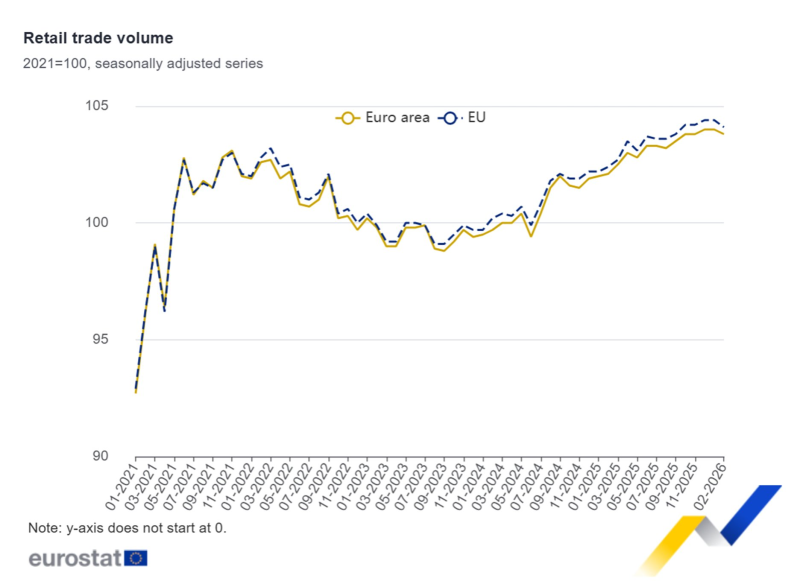
As EU_Eurostat reported, retail trade volume decreased by 0.2% in the euro area and 0.3% in the EU in February 2026 compared with January - while increasing by 1.7% year-over-year.
The monthly decline appears as a small dip near the top of the range - corrective rather than directional, with the broader structure remaining intact.
On the chart, this decline appears as a small dip near the top of the range rather than a structural shift. Both the euro area and EU lines remain close to their recent highs, indicating that the move is corrective rather than directional.
From EU Retail Recovery Trend to Plateau
The longer-term structure shows a transition from recovery into consolidation. After volatility in 2021-2022, retail volumes gradually stabilized and began trending higher through 2023 and 2024. By 2025, the pace of gains slows and the chart begins to flatten - instead of continuing to print strong higher highs, the index moves sideways near the upper band around 103-104.
This shift signals that upward momentum has cooled, with the trend evolving into a plateau rather than extending higher. A key structural element is the consistent support above the 100 index level - since 2023, pullbacks have remained contained above this baseline, reinforcing a higher trading range. The latest decline does not break this structure.
Mixed EU Retail Sector Moves Shape the Pattern
The underlying data shows diverging sector performance that helps explain the sideways movement in the aggregate chart:
- Food, drinks, and tobacco declined by 0.5%
- Non-food products were stable in the euro area and slightly down in the EU
- Automotive fuel increased by up to 1.0% in the EU
Gains and declines are largely offsetting each other, producing a stable aggregate trend rather than a directional signal in either direction.
Gains and declines are offsetting each other at the sector level - producing a stable aggregate rather than a directional signal, which is itself a form of resilience.
EU Jobless Rate Holds Steady at 6% provides supportive context for why retail volumes are holding at elevated levels - stable employment tends to underpin consumer spending even when monthly fluctuations occur.
EU Retail Stability Near Highs Defines the Current Structure
The chart does not show acceleration, but it also does not show breakdown. Retail trade volumes remain elevated, holding near the upper end of the range established over the past two years. E-Waste Rises as Electronics Output Up 78% and EU STEM Data: 7.9M Women Scientists and Engineers Across Regions both point to a broader European economic environment characterized by gradual structural change rather than sharp cyclical swings - consistent with the retail picture now taking shape.
For now, EU retail trade is not trending sharply in either direction. It is stabilizing at higher levels, with the structure suggesting continuation through consolidation rather than any meaningful reversal of the recovery trend established since 2022.
 Marina Lyubimova