Usman Salis
Europe's environmental economy kept building momentum in 2023, extending a decade-long rise in both jobs and output. Fresh Eurostat figures show the sector reaching 5.8 million full-time equivalent jobs while total output climbed to €1.33 trillion - reinforcing the idea that environmental activity is becoming a larger and more durable part of the EU economy.
A Green Economy Labor Trend That Never Turned Lower
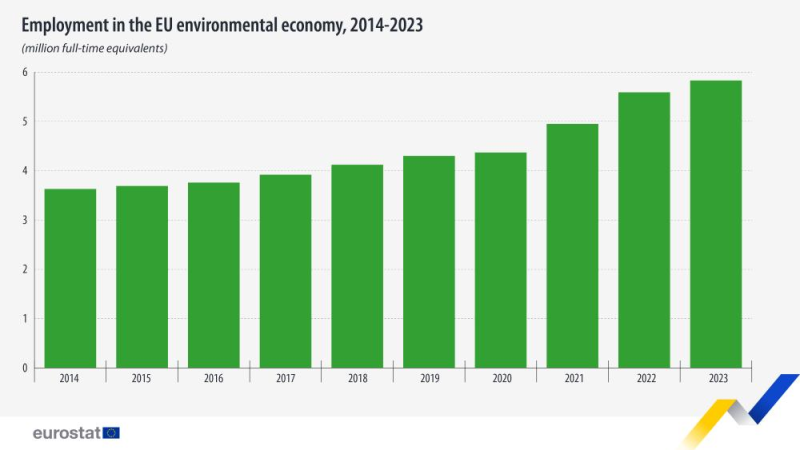
As EU_Eurostat reported, employment in the EU environmental economy increased from 3.6 million full-time equivalents in 2014 to 5.8 million in 2023 - a gain of 2.2 million over the period. The chart shows a steady climb rather than a stop-start cycle, with each year finishing above the last and the 2022-to-2023 increase taking employment from 5.6 million to 5.8 million.
The rise is gradual through the middle of the decade, then becomes more pronounced in the early 2020s - structural expansion rather than a cyclical spike defines this labor trend.
That pattern matters because it points to structural expansion rather than a one-off spike. The rise is gradual through the middle of the decade, then becomes more pronounced in the early 2020s - suggesting that environmental protection and resource management activities are absorbing a larger share of the EU labor base over time.
EU Green Economy Output Growth Picked Up in the Final Stretch
The second chart tells a similar story for output. The EU environmental economy generated €1.33 trillion in output in 2023, up 4.3% from 2022 and nearly double the €0.68 trillion recorded in 2014. The visual trend is especially notable after 2020, when the slope steepens and output moves decisively above the €1 trillion mark before reaching a new high in 2023.
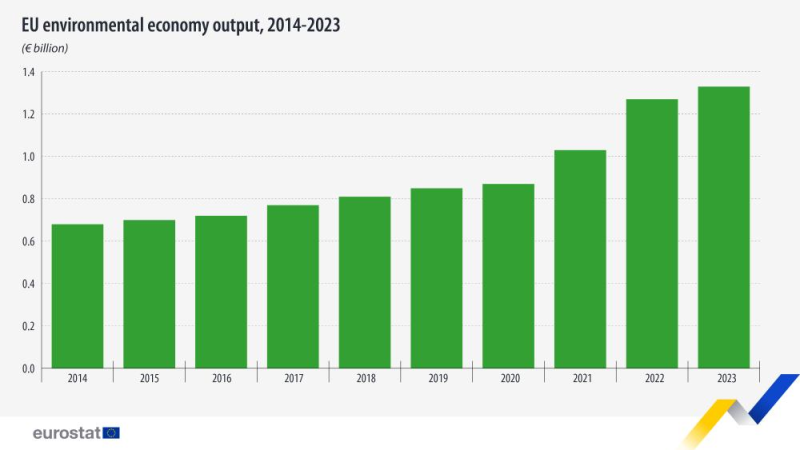
Rather than showing volatility, the chart reflects persistent annual gains. Output is growing faster than employment over the long run - making the environmental economy stand out as a segment where scale and economic value are increasing together.
E-Waste Rises as Electronics Output Up 78% adds a complementary dimension to this picture, showing how the growth of the broader technology economy is simultaneously generating new environmental management challenges - a dynamic that partially explains the sustained demand for environmental sector employment.
Two EU Green Economy Charts Pointing in the Same Direction
What makes the dataset compelling is the alignment between the labor and output curves. Employment rises consistently across the full period, while output not only rises but accelerates in later years. That combination suggests the sector is growing in both size and economic weight simultaneously.
Employment rises consistently while output accelerates - the sector is growing in both size and economic weight, a combination that points to durable rather than fragile expansion.
Eurostat's definition covers both environmental protection activities - such as waste and wastewater management - and resource management activities including energy efficiency measures in construction, renewable energy production, and forest management. That broad base helps explain why the growth path looks durable rather than concentrated in a single niche.
EU Jobless Rate Holds Steady at 6% provides broader labor market context, showing that green economy job growth is happening alongside overall employment stability rather than at the expense of other sectors. EU STEM Data: 7.9M Women Scientists and Engineers Across Regions adds another dimension to the EU's evolving workforce picture, with technical expertise increasingly underpinning the environmental economy's expansion.
The 2023 data does not show a sector peaking. It shows one still expanding - with more workers, higher output, and a stronger position inside the broader EU economy than it held a decade ago.
 Usman Salis