Editorial staff

AI video generation is altering the equation completely. And, as of now, the model that’s pushing the limits of what we can see is Google DeepMind’s Veo 3 — a system able to generate cinematic, 1080p video with synchronized audio and physically correct motion and character consistency from just a text prompt. And for those developers who wish to work off this asset a little further, the Veo 3 AI API serves as their entry point. And for teams that want to make that gateway smaooth, cost-effective, and not necessarily locked-in to any particular vendor in the world of APIPASS is indeed the platform provider.
Why is the Veo 3 AI so Revolutionary from Google?
To get a sense of what APIPASS unlocks, it helps to appreciate just how much of a leap Veo 3 is — not only over its predecessors but the entire landscape of AI video generation.
Google DeepMind says Veo 3, its latest video generation model, is rearchitected from the ground up to produce more realistic videos that stay closer to prompts and give users greater creative control than previous generations. The newest version, Veo 3.1 has even more tools for filmmakers and storytellers. Here is what sets it apart.
Native audio-video co-generation.
Veo 3 is the first video generation model to natively produce audio — not as an afterthought or secondary processing step but as a core component of the generation process itself. That means a single prompt can now provide specifications for dialogue, ambient environmental sound, tone of any music that might play and sound effects — all seamlessly rendered in lockstep sync with what’s on-screen. A scene that takes place in a rainy alleyway doesn’t just look wet — it sounds wet, with the patter of rain on pavement, distant traffic and whatever else the creator dictates. For developers, this reduces what was once a multi-tool pipeline — video generation, audio synthesis, post-production sync — to a single call to an API. The savings in creative and engineering overhead are enormous.
Re-designed for greater realism.
Veo 3 has been constructed with a vastly better understanding of how the physical world actually works. Fluids flow using real fluid dynamics. Fabric has a conversation with wind and gravity. Light reflects off surfaces in ways that feel photographic rather than algorithmically approximated. This attention to real-world physics stretches far beyond just how objects interacted or even what camera motion felt like, even into how environments reacted to the action within them. The result is that the video doesn’t look AI-generated—it looks shot. To product developers, this degree of realism, is what separates the demo that wow’s from the offering that converts.
Do as you’re told like it never could before.
One of Veo 3’s most practically useful breakthroughs is its prompt fidelity — how accurately it understands and follows complex instructions. Earlier models sometimes needed extensive prompt mining to achieve something close to the target output but were not consistent across cinematic concepts such as specific camera angles, lens types, lighting styles or narrative paced. The Veo 3 closes this gap significantly. Cinematographic language — “slow dolly push into a medium close-up,” “golden hour backlight with lens flare” — is common parlance and gets rendered accurately. That tighter link between creative intent and output makes the model practical enough for actual professional workflows, not just experimentation.
Better control of the creative process, including audio.
Veo 3.1 provides a full toolbox of controls for creators and developers to finely manage their outputs. Reference image inputs help users ground the scene, character, or object to a particular visual identity, maintaining consistency with existing brand assets or story elements. Style matching lets creators grab the aesthetic of a reference image — whether that’s a watercolor painting, a 35mm film photograph or retro animation — and slap it onto entirely new generated content. The character consistency controls solve one of the longest-standing problems in AI storytelling: making sure the same character stays looking like himself from shot to shot and scene to scene. Outside these, the toolkit offers clip extension for crafting longer narratives, first-and-last-frame transitions for deliberate scene setup shots, outpainting to extend the video frame in any direction and granular camera motion controls covering dolly, pan, tilt, zoom and tracking shots. These are not side-show add-ons — they’re the mechanisms that pull Veo 3 up from a content generator into a real production tool.
The Challenges of Accessing the Veo 3 AI API
Veo 3's capabilities are extraordinary. But getting access to the API and putting it to use in an actual product is not as simple as the technology itself sounds.
The first barrier is cost. Official access via Google Vertex AI prices an 8-second video with audio at about $6.00 — a cost that renders large-scale use or frequent iteration actually prohibitive for smaller teams and independent developers. At that price point, experimentation is expensive, and production at scale can become financially unsustainable long before a product ever gets into its users’ hands.
Then there are regional restrictions. The ability for direct communication with the API may be restricted or completely absent depending on where a team resides, effectively locking out much of the global developer community from one of the most powerful tools in AI.
And last, but not the least, is the integration experience. Padded and vague documentation, rate-limits that are not well-defined, and limited developers to assist can convert what should be a creative tool into an engineering hurdle. Teams find themselves spending more time wrestling with infrastructure concerns and not building what they came to build.
These are the limitations APIPASS was designed to overcome.
Why Should You Access Veo 3 AI Via APIPASS?
APIPASS is an AI model API aggregation, relay and developer accessibility platform. Specifically for the Veo 3 AI API, there are multiple advantages that no other access point can provide you at this time.
Transparent Pricing, Well Below Official Channels
APIPASS is priced on a pay-as-you-go credit system — no subscriptions, no minimum commitment, no lock-in. The pricing speaks for itself:
| Move to the Platforms | 8s Video with Sound | Price/Second |
| APIPASS (Fast Mode) | $0.40 | $0.05 |
| APIPASS (Quality Mode) | $2.00 | $0.25 |
| Google Vertex AI | $6.00 | $0.75 |
| Replicate. | $6.00 | $0.75 |
| Fal. ai | $6.00 | $0.75 |
A team can make fifteen 8-second videos for what it would cost on competing platforms at APIPASS's Fast Mode rate. That is not a slight difference — it’s the difference between a product that is able to iterate and one that can’t.
Global Access, Zero Geo-Restrictions
APIPASS removes regional barriers entirely. No matter if your team is in Singapore, São Paulo, Berlin or anywhere else in the world: with a single registration you have complete and unlimited access to the Veo 3 AI API. No approvals, no wait lists, no workarounds.
A Dual-Mode Support For All Cases
APIPASS is a single unified interface to access both Veo 3 Fast and Veo 3 Quality modes:
- Fast Mode is optimized for rapid prototyping, real-time applications and high-volume batch generation — maximum throughput at minimum cost per asset.
- Quality Mode for commercial-grade scenarios with a priority in visual and audio fidelity — brand campaigns, professional content production, polished consumer-facing outputs.
Only a single parameter setup change is needed to swap between each mode allowing for easy usage of Fast Mode during development and Quality Mode during the final production runs.
High-Concurrency Infrastructure
APIPASS is designed to handle production workloads. Such infrastructure can handle parallel video generation jobs at scale, with near-constant response times and output quality for a single test case or hundreds of concurrent actual generation requests direct from your product. For teams that are building automated pipelines or managing unpredictable bursts of traffic, that reliability isn’t a nice-to-have — it’s critical.
Getting Started with Veo 3 AI on APIPASS
The onboarding process is meant to remove friction. The average developer is making their first successful API call less than ten minutes after signing up.
Step 1: Sign up + Get your API key.
Head over to APIPASS, register and you will find your API key in the dashboard right away. There is no approval process, and there’s no waiting period.
Step 2: Play around in the Playground.
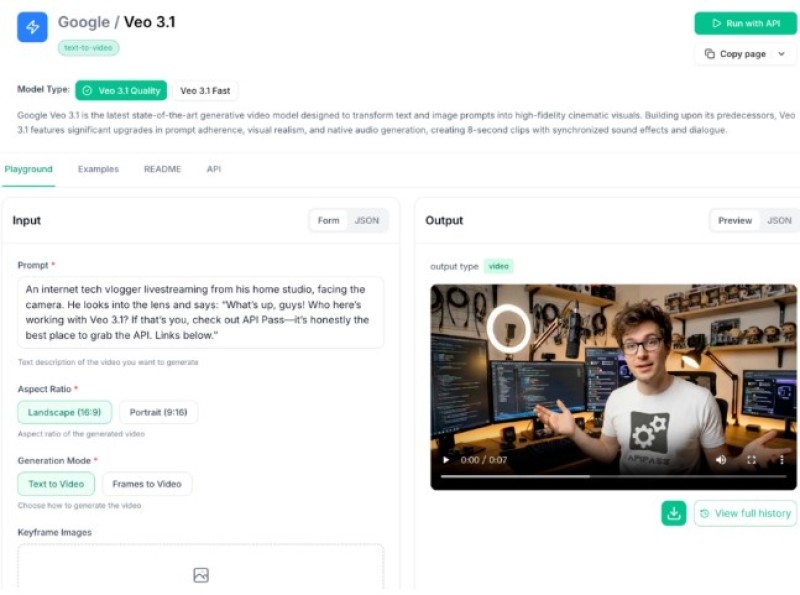
In the built-in Playground environment of APIPASS, new users can try the API by using trial credits for free. Try out different prompts, build side-by-side comparisons of outputs in Fast and Quality mode sharing, and get a sense for how the model responds to various creative directions — without spending a penny of your budget.
Step 3: Connect using simple, developer-friendly docs.
API Documentation APIPASS complete API documentation with executable code snippets in Python and REST. The documentation goes into detail on authentication, formatting requests, handling responses and managing errors — all the pieces required to get from a working test to a production integration without gaps.
Step 4: Real-time usage monitoring.
The APIPASS dashboard provides real-time visibility into credit balance, job status, and past usage. Schedule alerts, monitor costs by project and scale generation volume up or down depending on your needs — all from a seamless interface.
Use Cases
Currents of real products and workflows using Veo 3 AI API on APIPASS Below are the circumstances in which teams are discovering the greatest value.
Platforms Content & Digital media
Veo 3 AI API is being built into publishers and content platforms that automatically spin up video assets from written material — articles, scripts, social posts. Rather than commissioning separate video production for each piece, editorial teams can transform text into short-form video in minutes with embedded narration and ambient sound. This results in a massive scale-up of the video output without an equal ramp up in production cost, with a broad continuity where video becomes an economically sound option at highest frequencies of publishing.
Marketing and advertising.
Veo is leveraging AI with the Veo 3 AI API, allowing marketing teams to generate brand video creatives at scale and speed that traditional production pipelines can only dream of. Assets that used to require days of filming and post-production can now be created from a prompt within minutes. APIPASS’s Quality Mode provides the cinematic quality that brand advertising requires, and the low per-asset price enables generative testing of many creative variants simultaneously — a functionality that revolutionizes campaign optimization.
EdTech and e-learning.
Using Veo 3 AI API, educational technology companies are now able to transform static course content into dynamic video lessons. Physics simulations, recreations of historical events, sequential process diagrams — all can be rendered at request from structured information. This is where Veo 3’s native audio generation is really powerful: instructional voiceover, illustrative sound design and the context of environment can be specified in a single prompt to create whole lesson segments with no need for additional tooling.
Games and interactive media.
With Unreal Engine 5 compatibility, game studios are using the Veo 3 AI API to rapidly iterate on visualizations for concepts, prototype cinematic cutscenes and even create live-action media assets sooner in the development cycle. With character consistency controls in Veo 3, it's now feasible to create several of the same character in different scenes — a feature that expands the scope for AI-assisted story design or pre-visualization processes.
Automated content pipelines.
Engineering teams are developing fully automated, server-side pipelines that automatically kick off Veo 3 generation jobs in response to content events — new product listings, user actions, scheduled publishing cycles. The parallel job queues that these systems create are handled by APIPASS’s high concurrency infrastructure, which means throughput scales with demand, rather than being a bottleneck.
Start Building Today
Video is the language of the internet, and the ability to programmatically generate it — at cinematic quality, with matching audio, and for a price point that makes it possible to scale — is one of the most powerful capabilities available to product teams today.
APIPASS provides that capability: low pricing, worldwide availability, dual-mode flexibility, and production workload-ready infrastructure. Whether you’re Audio Shipping your first prototype or scaling an established product, the Veo 3 AI API via APIPASS is the most efficient route from concept to video.
Go to APIPASS and register for free, get your API key and start building.
 Editorial staff