Editorial staff
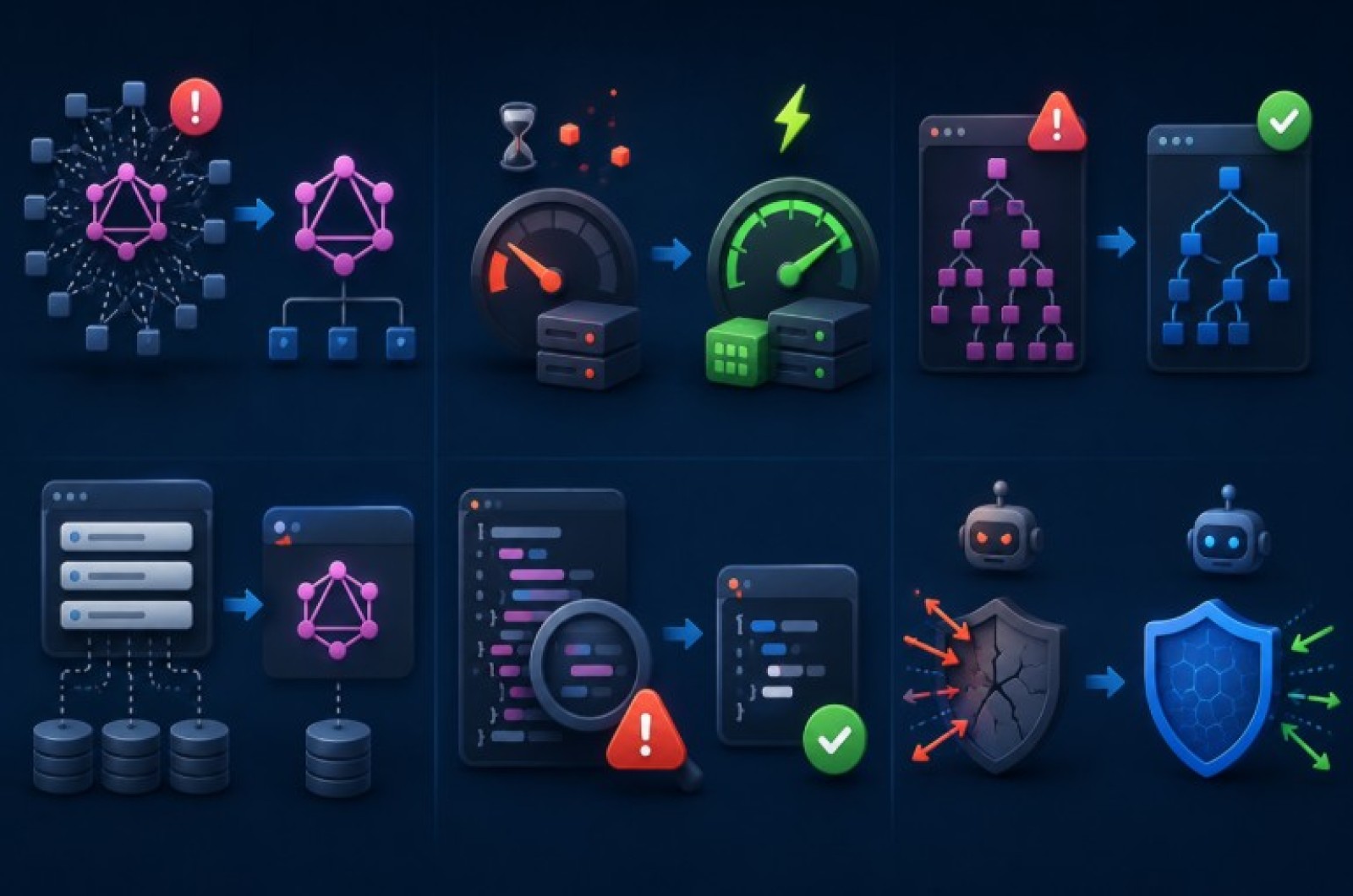
- Unbounded Query Complexity in Model-Oriented Workloads
- Oversized Payloads and Inefficient Data Retrieval
- N+1 Resolver Problem in Feature Store Access
- Lack of Caching for Model and Experiment Metadata
- Resolver Explosion in Vector Search and Model Registries
- Running Heavy ML Inference Inside Resolvers
- Conclusion
By- Satishkumar Rajendran
The adaptability of GraphQL and its client-oriented query model has rendered it a preferred choice in modern data platforms. It can be used in AI systems to combine model metadata, organize workflows, and access distributed services, such as experiment tracking systems and feature stores. However, its advantages can very easily become constraints when it is applied to AI applications that demand high performance.
GraphQL can be applied in structured metadata queries and in connecting two or more back-end services. It is inefficient to invoke when engaging in heavy computation, accessing large vectors, or handling heavily nested resolver chains. These are among the boundaries that ought to be studied. The following sections provide a discussion of the six most important performance pitfalls that are unique to AI-driven architectures and the ways they can be addressed.
Unbounded Query Complexity in Model-Oriented Workloads
A typical presentation of interrelated entities often found in AI platforms includes models, datasets, experiments, and feature pipelines. GraphQL allows these relations to be traced in a query without limitation, which results in limitless depth and complexity of queries. A request that asks for model versions, associated datasets, and experiments together with evaluation metrics may result in multiple backend services being triggered simultaneously.
Dependencies on model registries and experiment tracking systems further increase this complexity in AI environments. The final effect is an imbalance in latency and a congested back end. As a means of guaranteeing predictability of performance without sacrificing flexibility, query depth can be restricted, complexity scoring may be employed, and costly queries can be rejected at an early stage.
Oversized Payloads and Inefficient Data Retrieval
The GraphQL system is flexible enough to allow clients to query the server for what they desire, although poorly defined schemas can readily lead to over-fetching in AI applications. To give an example, when a client poses a query to a feature store, they may inadvertently request all feature vectors or past information when only a subset is required.
This inefficiency causes increased payload size, increased network latency, and increased downstream processing time in AI pipelines. The application of clearly defined fields in organizing the schema, projections that are easy to work with, and the use of pagination will ensure that no unnecessary information is accessed. This is especially necessary in vector search systems, where payload size has a direct influence on response times.
N+1 Resolver Problem in Feature Store Access
The N+1 issue is much more pronounced in AI systems that involve feature retrieval. A query containing features for more than one entity can lead to one initial query followed by dozens or even hundreds of calls to a feature store.
One such situation is that retrieving user-level features for 100 entities may lead to 101 back-end calls when the resolvers are not optimized. This causes distributed feature stores to experience high latency and increased resource consumption. Introducing batching, such as using DataLoader, and reassigning resolvers to groups of feature requests may significantly decrease the number of back-end calls and lead to reduced latency and throughput improvements.
Lack of Caching for Model and Experiment Metadata
AI systems are based on metadata such as model versions, training configurations, dataset descriptions, and experiment results. This is often consulted and rarely updated information. Nevertheless, a large number of GraphQL APIs retrieve this metadata by querying databases for each request.
This is a waste of computing power, and response time is increased. Redis and HTTP caching headers will ensure that performance is significantly improved by implementing a higher level of caching, i.e., resolver-level in-memory caching. Model metadata API caching has the potential to save milliseconds or even microseconds of response time, resulting in overall more responsive systems.
Resolver Explosion in Vector Search and Model Registries
Expanding resolver chains that invoke vector databases or model registries are likely to result in exponentially growing resolver chains. For example, a query that retrieves similar embeddings, related metadata, and linked models may trigger a sequence of resolver calls that are conditional on each other.
This expansion of resolvers increases requests, whereby one client request is translated into numerous back-end operations. It is particularly problematic in the case of vector search systems, where each search may involve computationally intensive similarity calculations. This problem can be reduced by designing the schema to limit the number of resolver paths, grouping related data into fewer resolver calls, and precomputing relationships where possible.
Running Heavy ML Inference Inside Resolvers
Another error, which is one of the most significant in GraphQL-based AI architectures, is implementing machine learning inference in resolvers. GraphQL resolvers are usually synchronous; thus, one long-running inference can block the execution thread and put other requests on hold.
This leads to cascading timeouts and poor system performance under heavy load conditions. Instead, the API layer should not be tightly coupled with inference. Asynchronously generated predictions are expected to be stored in a feature store or a database and should be precomputed so that GraphQL performs retrieval rather than computation. This isolation of APIs allows inference workloads to remain responsive because they can scale independently.
Summary of Pitfalls and Solutions
| Pitfall | Symptom | Root Cause | Recommended Fix |
| Unbounded Query Complexity | High latency spikes | Deep nested queries across services | Enforce depth and complexity limits |
| Oversized Payloads | Large response sizes | Over-fetching in schemas | Use projections and pagination |
| N+1 in Feature Stores | Excessive backend calls | Per-entity resolver execution | Batch requests with DataLoader |
| No Metadata Caching | Repeated database hits | Lack of caching strategy | Introduce multi-layer caching |
| Resolver Explosion | Request amplification | Chained resolver dependencies | Consolidate and precompute data |
| Inference in Resolvers | Blocking and timeouts | Synchronous execution model | Decouple inference from API |
Conclusion
GraphQL has proven to be effective in AI systems when it is deployed in its area of strength. It is very good as a metadata aggregator, coordinator, and access layer for distributed services. However, it does not facilitate heavy computation, large-scale vector retrieval, or highly nested execution paths.
In order to attain performance, it is required to avoid pitfalls such as uncontrolled query complexity, inefficient data retrieval, resolver inefficiencies, and simultaneous execution of inference. Through the addition of query constraints, schema optimization, caching, and decoupling computation from retrieval, teams can create flexible and fast GraphQL APIs. Properly used, GraphQL can be a safe interface layer that does not interfere with AI workloads but supports them.
 Editorial staff