Saad Ullah

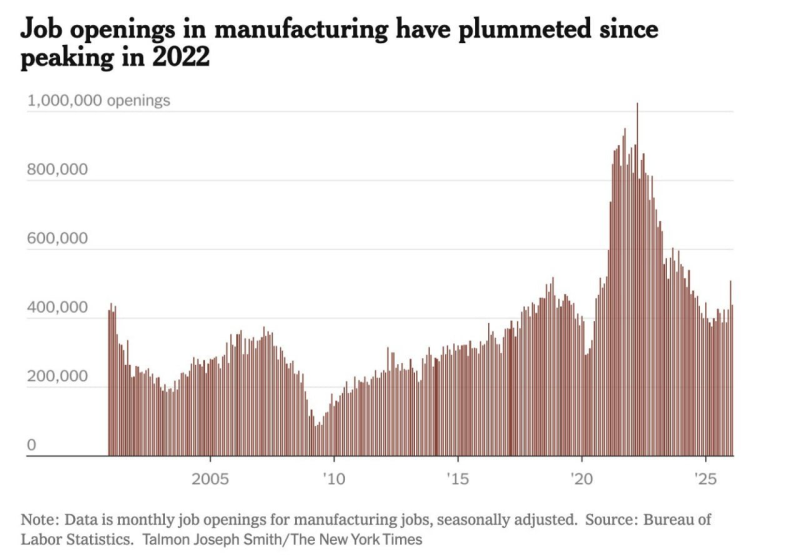
The post-pandemic surge in U.S. manufacturing is fading fast. Job openings, once nearing 1 million at their peak in 2022, have since entered a persistent downtrend - reflecting a clear cooling in labor demand and raising concerns about the strength of the industrial economy.
The Peak That Marked the US Manufacturing Shift
The chart shows a pronounced topping structure in 2022, where job openings reached extreme levels before reversing sharply. That peak stands out as an exhaustion point rather than a sustainable plateau.
Following that high, the data transitions into a clear pattern of lower highs and lower lows. Each recovery attempt has been weaker than the last, confirming a structural shift rather than a temporary correction. By 2024-2025, openings have fallen back toward the 400,000-500,000 range - cutting a significant portion of the prior expansion.
As Solix Trading noted, the narrative of a manufacturing comeback contrasts sharply with the ongoing erosion in labor demand visible in the data.
A Manufacturing Labor Downtrend With Weak Recoveries
The defining feature of the current structure is not just the decline, but the failure of rebounds. Momentum has consistently rolled over before reclaiming previous levels:
- Repeated rejection below prior peaks
- Gradual compression of upside moves
- Stronger downside phases compared to recoveries
The 400,000 level now acts as a soft support zone - but repeated tests without strong bounces suggest weakening stability. The 600,000-650,000 range has transitioned into resistance, capping any meaningful recovery attempts before they can develop into a trend change.
U.S. Job Market Weakens as Private Payrolls Drop shows how the manufacturing-specific weakness is playing out within a broader labor market softening - reinforcing that the decline in industrial job openings is not an isolated sectoral story but part of a wider cooling in hiring demand.
US Manufacturing Labor Demand Still Losing Strength
The broader takeaway from the chart is the persistence of the trend. This is not a sudden drop - it is a multi-year decline in hiring demand within manufacturing that shows no sign of stabilizing.
U.S. Job Growth Drops to Pre-Recession Levels places the manufacturing data within a broader historical context, showing how current job growth levels compare to prior periods of economic stress - and what that comparison implies for the trajectory ahead. Labor Market Shows Signs of Cooling Across Key Sectors reinforces that the cooling visible in manufacturing is echoing across multiple sectors simultaneously, making a manufacturing-specific recovery harder to sustain even if sentiment improves.
From a technical perspective, the trend remains intact to the downside. A sustained move back above the 600,000 zone would be needed to challenge the current structure - and without that, the chart continues to reflect declining demand with pressure building near the lower range.
 Saad Ullah