Usman Salis

There is a large imbalance embedded in the U.S. banking system, and the numbers make it hard to ignore. Solix Trading flagged this structural issue, pointing out that unrealized losses surged sharply in 2022 and, despite a partial recovery, remain deeply negative heading into 2025 - a sign that the apparent stability may be more cosmetic than structural.
These losses remain unrealized, which allows the system to appear stable despite underlying pressure.
The $700B Breakdown That Redefined U.S. Bank Balance Sheets
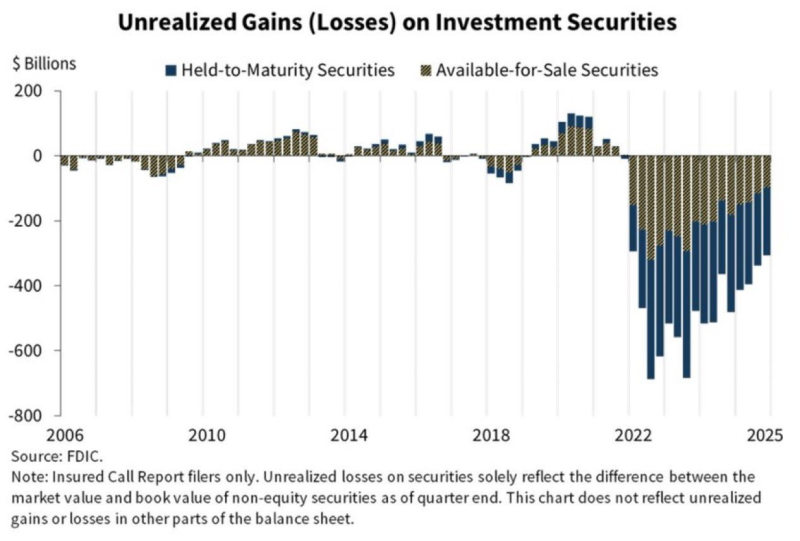
From 2006 through 2021, unrealized gains and losses in the U.S. banking sector fluctuated near equilibrium, rarely drifting far from the zero line. That balance broke decisively in 2022. Losses expanded rapidly, with held-to-maturity securities dropping toward nearly -$700 billion at the worst point, while available-for-sale portfolios also moved sharply negative. The shift was fast and structural - not the kind of gradual drift that gets smoothed out over a couple of quarters.
What followed was not a full recovery. Instead, the system stabilized at a much lower baseline, one that most investors and depositors probably don't think about on a daily basis. BTC, S&P 500, and Gold All Drop Below Key Levels in a Synchronized Risk-Off Sell-Off - a pattern that echoes similar structural stress points playing out across asset classes.
A Structure That Never Returned to Normal After 2022
The most important signal here is not just the size of the drawdown - it is the failure to reclaim prior levels. Even into 2025, unrealized losses remain clustered in a deeply negative range, roughly between -$300 billion and -$500 billion. That is compression inside a negative range, not normalization.
- The zero line has not been reclaimed since 2022
- Rebounds stall well below historical equilibrium
- Losses persist across both major asset categories
- The deepest stress remains in held-to-maturity securities
There is no structural reset - only a partial rebound followed by sideways movement at depressed levels. That suggests the imbalance is still present, simply not yet forced into realization.
Broader market dynamics reinforce this picture. Gold (XAU) Price Reveals USD's Silent 8.4% Annual Decline - a dynamic that sits in the same macro environment that continues to suppress the recovery of bank balance sheets.
$306B in Unrealized Losses: Stability Without Resolution
From a structural standpoint, the data does not describe a completed recovery cycle. There is no return to equilibrium, no move back to positive territory, and no evidence of a new uptrend forming in bank portfolios. The system appears to be holding within a new, lower range where losses remain persistent but contained.
That distinction matters more than it might seem. A contained loss is a deferred problem, not a solved one. As periods of synchronized weakness across assets and valuation distortions tend to emerge before structural shifts fully materialize, the question is not whether these losses exist - it is when and how they eventually get resolved. Managing Wealth in a Mobile-First World Through Digital Platforms explores how retail investors are navigating exactly this kind of environment.
 Usman Salis