Marina Lyubimova
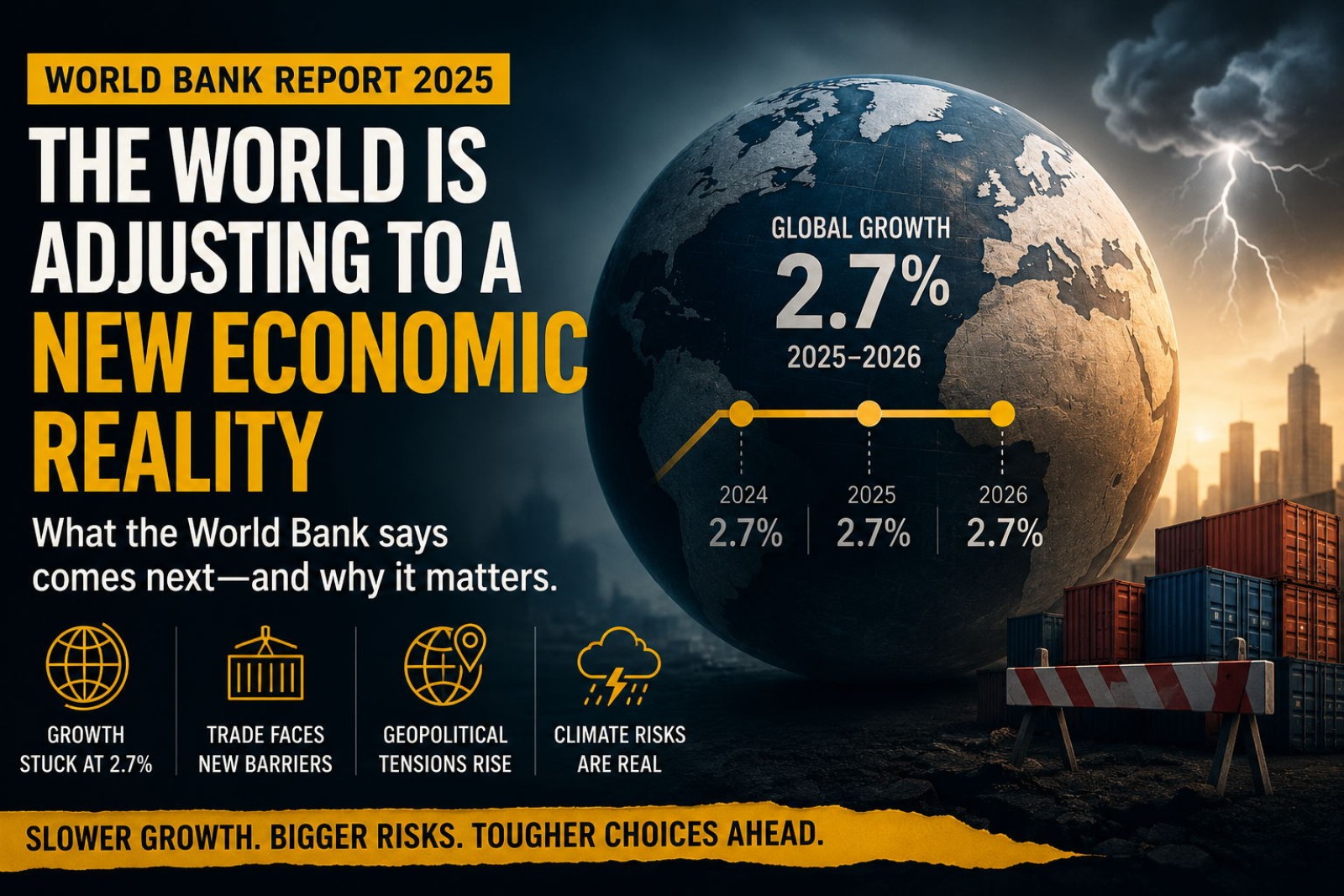
Global GDP is expected to expand by 2.7% in both 2025 and 2026. On paper, that suggests stability. In reality, economists are increasingly concerned that the global economy is settling into a pace that is too slow to deliver meaningful improvements in living standards for millions of people. The issue is not an imminent recession. It is the possibility that low growth becomes the new normal.
| Year | Global GDP Growth |
| 2024 | 2.7% |
| 2025 | 2.7% |
| 2026 | 2.7% |
Why Economists Are Talking About a "Low-Growth Era"
For decades, economic development followed a familiar pattern. Countries invested in infrastructure, businesses expanded across borders, international trade accelerated, and living standards gradually improved. Today, that model is facing increasing pressure.
The World Bank points to several forces that are reshaping the global economy:
- rising policy uncertainty;
- growing geopolitical tensions;
- changing trade policies;
- persistent inflation pressures;
- climate-related disruptions.
Individually, none of these factors is enough to derail global growth. Together, however, they create an environment in which economic progress becomes harder to sustain.
| Risk | Impact Level |
| Trade Policy Shifts | High |
| Geopolitical Tensions | High |
| Policy Uncertainty | High |
| Persistent Inflation | Medium |
| Climate Disasters | Medium |
Trade Is No Longer Working the Way It Used To
One of the biggest shifts highlighted by the World Bank involves international trade. For much of the past three decades, globalization helped companies reduce costs and improve efficiency by spreading production across multiple countries. Trade became one of the most important drivers of global growth.
That trend is now changing. Governments are increasingly prioritizing economic resilience and national security alongside efficiency. Supply chains are becoming more regional. Strategic industries are receiving government support. New trade barriers are appearing in sectors ranging from technology to manufacturing.
The result is a world economy that may be more resilient to shocks, but potentially less efficient than before.
Why Developing Countries Face a Bigger Challenge
Perhaps the most important message in the report concerns emerging and developing economies.
The World Bank warns that many countries are no longer catching up with advanced economies at the pace seen during previous decades. Income growth is slowing, productivity gains are becoming harder to achieve, and external conditions are less favorable than they once were.
| Economy Group | Expected Growth |
| Advanced Economies | 1.7% |
| Emerging & Developing Economies | 4.0% |
| Low-Income Economies | 5.6% |
While developing economies continue to grow faster than advanced nations, the gap has narrowed compared with earlier periods of globalization.
This matters because economic convergence has historically been one of the strongest mechanisms for reducing global inequality. Slower convergence means it may take far longer for lower-income countries to reach higher standards of living.
What Needs to Change
The World Bank argues that stronger long-term growth will not come from short-term stimulus measures alone.
Instead, countries may need to focus on:
- improving productivity;
- strengthening economic institutions;
- encouraging investment;
- supporting infrastructure development;
- adapting to climate risks;
- maintaining open and predictable trade relationships.
In other words, the challenge is becoming less about managing crises and more about creating conditions for sustainable growth.
The Bigger Question
The World Bank's latest outlook raises an uncomfortable possibility. The global economy may not be heading toward another major downturn, but it may also not be returning to the rapid expansion that defined much of the pre-pandemic era.
Growth is still expected. Trade is still expanding. Development is still possible. The question is whether the world can generate enough momentum to avoid becoming trapped in a prolonged period of economic underperformance.
 Marina Lyubimova