Victoria Bazir
Sri Lanka has been through one of the most dramatic economic collapses in recent memory. After years of monetary mismanagement and a debt crisis that brought the country to its knees in 2022, the latest inflation data suggests the recovery is holding. January's 2.4% reading isn't just a number - it's a signal that monetary conditions have normalized enough to keep prices in check.
Inflation Undershoots the 5% Target
Sri Lanka's inflation came in at 2.4% year over year in January, missing the country's 5% inflation target by a wide margin. The number lines up with where monetary conditions have been pointing for a while. According to economist Steve Hanke, Sri Lanka's M2 money supply grew at 11.3% per year in December 2025, sitting comfortably below his Golden Growth Rate of 14.3% - a benchmark he ties directly to hitting that 5% inflation goal.
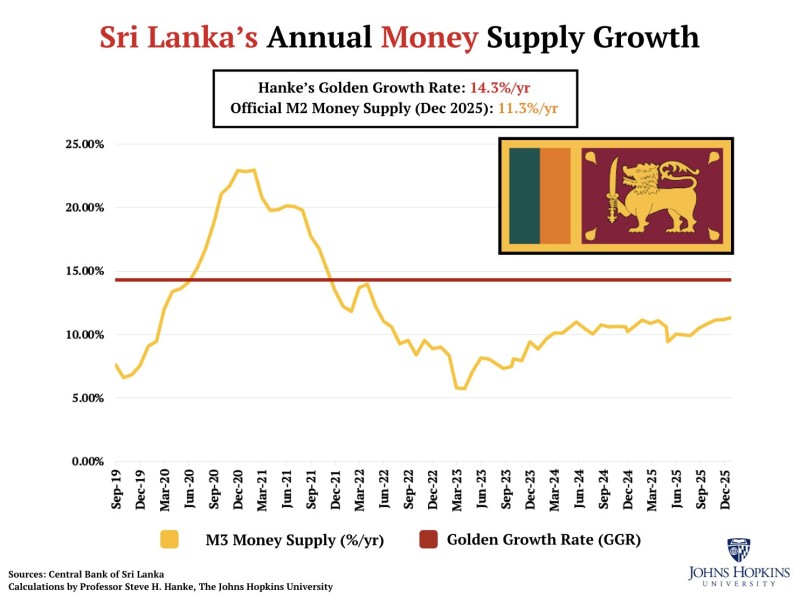
The money supply story here isn't new. Sri Lanka saw M2 growth spike above 20% in 2020 and 2021, which contributed to severe price pressures at the time. Since then, growth has trended lower, stabilized, and gradually recovered through 2024 and 2025 - but still hasn't crossed back above the 14.3% threshold.
Sri Lanka's official M2 money supply growth in December 2025 was 11.3% per year, below the Golden Growth Rate of 14.3% per year.
Same Pattern Seen Across Global Markets
The gap between 11.3% and 14.3% is doing the explanatory work here. When money supply growth runs below the Golden Rate, inflation tends to follow suit and stay under target. Sri Lanka fits neatly into that pattern, and it's not alone. A similar dynamic played out in UK inflation cooling as money growth stays below the Golden Growth Rate, where M4ex growth fell short of benchmark and CPI followed lower.
The same framework has been applied in Sweden inflation undershooting target alongside below-benchmark money growth, where M3 came in under Hanke's country-specific rate and inflation dropped sharply. And in the US, US money supply growth falling below the Golden Rate has been used to frame the broader disinflationary trend that played out over 2023 and 2024.
Sri Lanka's January reading adds one more data point to that growing list - countries where monetary conditions predicted the inflation outcome before it showed up in the headline number.
 Victoria Bazir