Peter Smith
World Bank GDP forecasts for 2025-2027 confirm what many economists have long argued: South Asia's strong growth numbers are largely an India story. Strip out India, and the region looks considerably less impressive.
India vs. South Asia: What the Numbers Actually Show
According to World Bank projections flagged by economist Steve Hanke, South Asia holds a growth rate near 6 to 7 percent through 2025-2027 when India is included in the regional aggregate. Remove India from the equation, and that figure drops to roughly the low-to-mid 4 percent range in 2025, recovering only toward the mid 5 percent area by 2027.
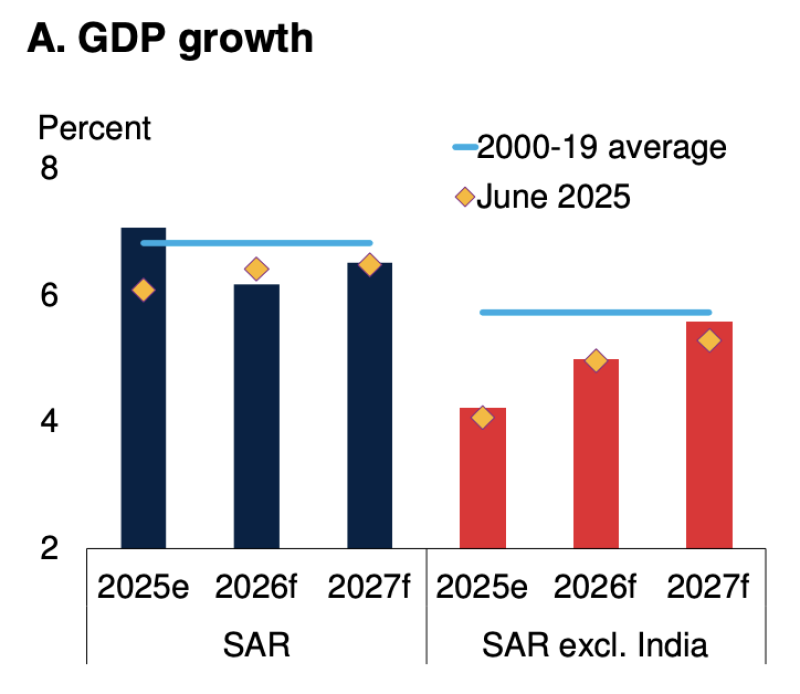
The gap is hard to ignore. With India in the dataset, the region tracks close to its own 2000-2019 long-term average. Without it, the "excluding India" series sits materially below that historical benchmark across the entire forecast window.
The comparison underscores that India is the growth story in the region.
This matters beyond a statistical footnote. It shows that regional expectations effectively hinge on the performance of a single large economy, which creates a concentration risk that broader South Asia outlooks don't always make obvious.
India's Edge: Fast Growth, Low Inflation
India's dominance in the regional numbers is backed by a broader economic picture. The country remains among the fastest-growing major economies heading into 2025, and what makes its position more unusual is that this expansion comes alongside record-low inflation readings - a combination most large economies have struggled to achieve.
The contrast with global trends is notable. While India pushes regional averages higher, the wider global picture is deteriorating. The World Bank has already cut its 2025 global GDP forecast to 2.3 percent amid rising risks, making India's trajectory look even more distinct from the broader international environment.
For South Asia as a whole, the takeaway is straightforward: the region's projected expansion is meaningfully weaker once India's contribution is set aside, and that gap is likely to stay wide as long as no other economy in the region approaches India's scale or pace of growth.
 Peter Smith