Eseandre Mordi
⬤ Traditional finance is still painfully slow. Sending money internationally takes 3 to 5 business days and costs $25 to $50 in fees, even as real-time communication costs nearly nothing. That gap has pushed serious attention toward blockchain solutions. XRP, XLM, and XDC are not chasing the same user or the same problem. They are built to fix different parts of the same broken system, which is exactly what makes the trio worth watching together.
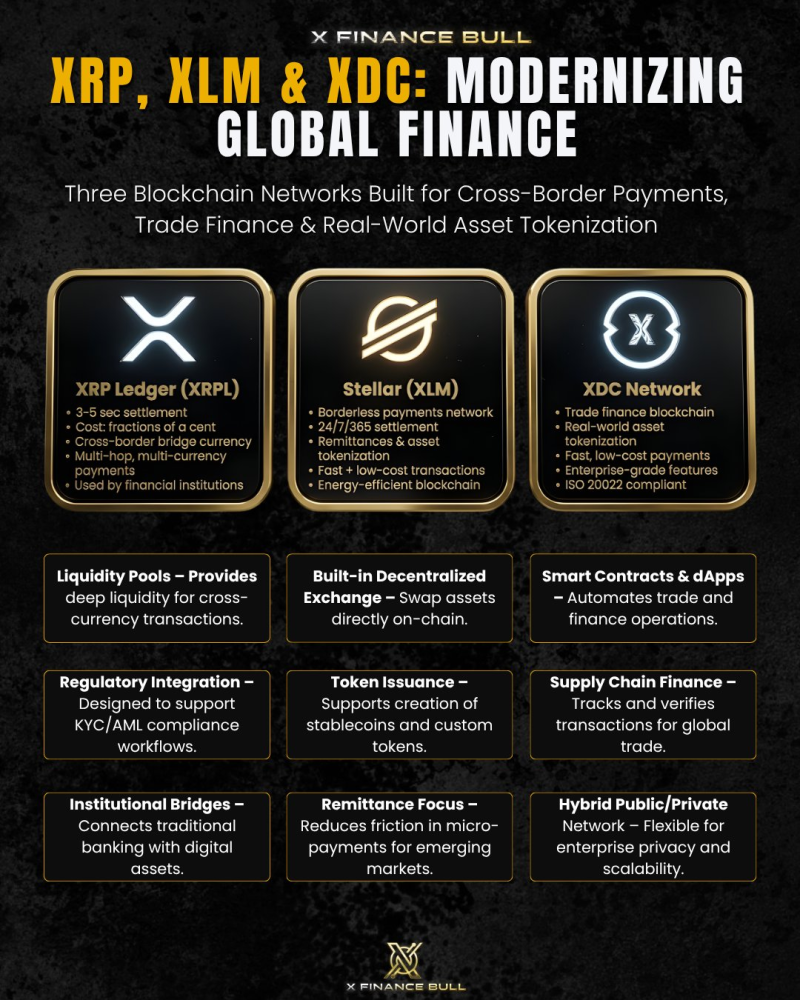
⬤ XRP functions as a bridge asset for cross-border payments, built for speed and institutional liquidity. Transactions on the XRP Ledger settle in seconds at fractions of a cent, a direct replacement for slow correspondent banking rails. That institutional angle is no longer theoretical: XRP and XLM integration into major financial systems has accelerated, with both assets gaining a foothold inside infrastructure operating at DTCC scale. Stellar's XLM runs a parallel track, targeting remittance corridors in emerging markets where small-value, low-fee transfers matter most.
⬤ XDC takes a different lane entirely, focusing on trade finance and supply chain workflows. Its ISO 20022 compatibility and real-world asset tokenization features make it a natural fit for enterprise environments. Taken together, the three networks divide the work: XRP handles liquidity and banking rails, XLM covers remittance corridors, and XDC targets trade and enterprise settlement. That segmentation is showing up in price behavior too, with XLM price movements and XRP correlation trends increasingly reflecting their underlying utility rather than pure speculation.
⬤ The broader picture is one of gradual, structural integration. XRP, XLM, and XDC are being adopted not as bets on a single outcome but as specialized layers addressing specific inefficiencies. The continued institutional adoption of XRP and XLM within DTCC-scale infrastructure suggests that blockchain's entry into traditional finance is moving from narrative to implementation.
 Eseandre Mordi