Eseandre Mordi

⬤ XRP Ledger is making real inroads in institutional finance. More than $221 million in tokenized corporate credit has gone live in Brazil, operating under the Brazilian Virtual Assets Law, a regulated and compliant framework that gives this deployment serious credibility in traditional markets.
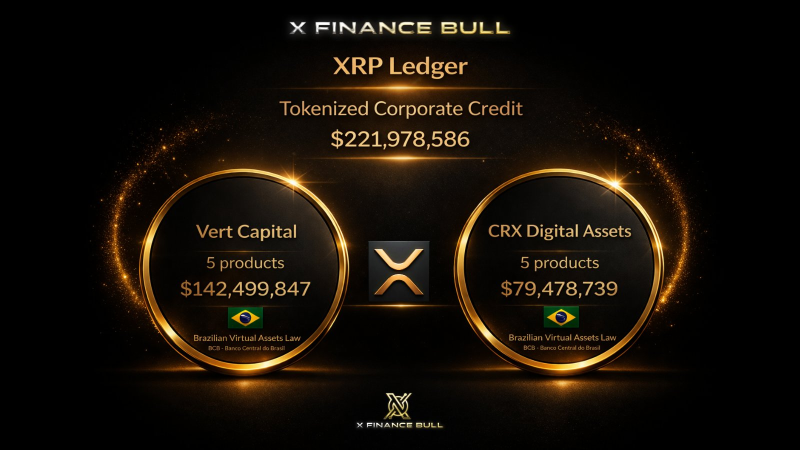
⬤ Two firms are driving the numbers. Vert Capital is handling multiple credit tranches worth over $142.4 million, while CRX Digital Assets has tokenized roughly $79.4 million in corporate debt tied to Aloo Telecom, DelRio, and Usina Coruripe. Together they account for the $221,978,586 total confirmed in the deployment data.
⬤ The choice of XRP Ledger comes down to basic operational efficiency. Transactions settle in seconds, fees stay at fractions of a cent, and the network is built around institutional compliance needs. These same strengths powered the Japan-Brazil payments corridor via RippleNet, where XRP infrastructure cut cross-border transfer times and costs significantly for major financial institutions.
⬤ Brazil has become a key testing ground for regulated tokenization. The country's domestic credit market runs into the hundreds of billions, and XRP Ledger's role in Brazil's $200B credit market continues to expand as more institutions move on-chain under clear legal frameworks.
⬤ What stands out here is the gap between XRP's growing real-world utility and how markets are currently pricing it. Regulated institutional adoption is accelerating, yet sentiment has not caught up. As tokenization scales globally and more credit infrastructure migrates to blockchain rails, that disconnect is likely to narrow.
 Eseandre Mordi