Usman Salis

⬤ Ethereum is absolutely crushing it in terms of actual network usage, and the numbers don't lie. According to fresh on-chain data from Santiment, ETH now leads all major blockchains with 167.96 million non-empty wallets. That's not just a marginal lead—it's a dominance statement. This kind of growth isn't coming from pump-and-dump hype cycles; it's real utility driving the numbers. From DeFi protocols to NFT platforms and token launches, Ethereum remains the backbone of crypto's infrastructure.
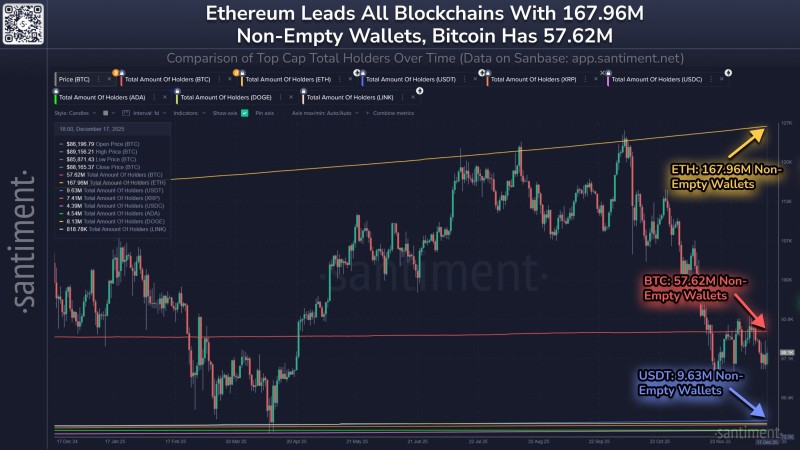
⬤ Bitcoin comes in second with 57.62 million non-empty wallets, which is still solid but nowhere near Ethereum's scale. The gap between them tells you everything about how these networks are being used. Bitcoin's strength lies in being digital gold—a store of value with concentrated holders. Meanwhile, Tether (USDT) sits at 9.63 million wallets, followed by Dogecoin (DOGE) at 8.13 million. These numbers show that stablecoins and meme coins still have serious traction when it comes to everyday transactions.
⬤ Further down the list, XRP, Cardano (ADA), USD Coin (USDC), and Chainlink (LINK) round out the rankings. Cardano has around 4.54 million active wallets, USDC sits near 4.39 million, and Chainlink trails with roughly 819,000 addresses. While most networks show steady growth, Ethereum's expansion curve is in a league of its own, reinforcing why it's still the primary settlement layer for decentralized apps.
⬤ Non-empty wallet counts are one of the best long-term health indicators for any blockchain. Price action gets all the headlines, but wallet growth tells you who's actually building and using the network. Ethereum's lead signals sustained adoption and real-world utility, while Bitcoin's lower count aligns perfectly with its role as a long-term value store. For anyone tracking network fundamentals, these wallet distribution trends are a critical signal that cuts through market noise.
 Usman Salis