Eseandre Mordi

A massive transfer of capital may become one of crypto's most important long-term themes. As TheCryptoBasic noted, Americans aged 60 and older currently hold around $110 trillion in wealth - and that money is expected to move gradually to younger generations over time. Because Millennials and Gen Z show materially stronger crypto ownership, the shift is increasingly being framed as a structural setup for future digital-asset demand.
The Wealth Curve Is Already Moving Toward Younger Generations
The chart points to a clear change in generational wealth distribution. Baby Boomers still hold the largest pool, while Gen X has also expanded its share over time. But the most notable move comes from Millennials, whose wealth has climbed sharply from a very low base in the early 2000s to a much larger position by late 2025.
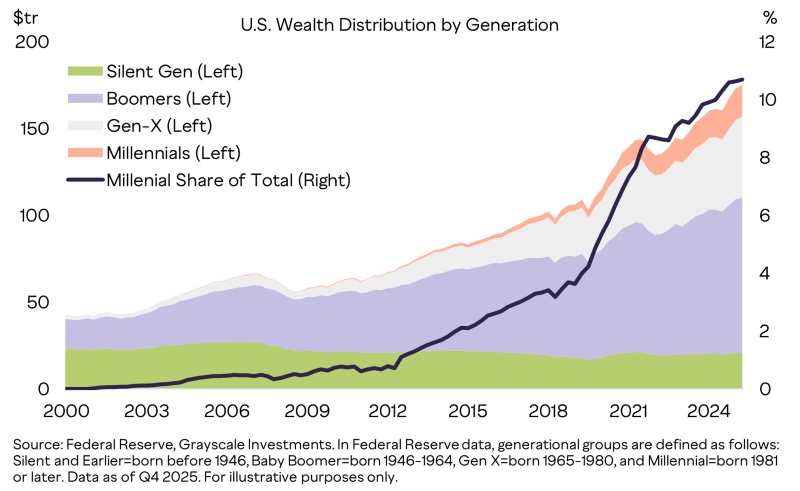
That rise is visible in two ways: Millennial wealth on the left axis grows steadily across the period, while the Millennial share of total U.S. wealth on the right axis accelerates above 10% by the end of the chart. The trend is unmistakably upward, showing that younger households are gaining a larger foothold in the national wealth mix.
Where Crypto Enters the $110T Wealth Picture
The source ties that shift directly to digital assets. According to the tweet, 45% of Gen Z and Millennials own crypto, compared with 18% of Gen X and Boomers. That gap is the core of the argument: if more wealth ends up in the hands of cohorts that are already more comfortable holding crypto, the asset class could benefit from that redistribution over time.
The estimate becomes more striking when expressed in allocation terms. A 2% allocation of the $110 trillion pool would equal roughly $2.2 trillion flowing toward crypto. That does not mean such an allocation is guaranteed - but it does show why the wealth-transfer narrative is attracting serious attention across the digital-asset market.
Younger investors are reshaping crypto demand not through a sudden event but through a gradual change in who controls capital - a process the chart shows is already well underway in measurable form.
A Long-Horizon Theme, Not a Short-Term Trade
The tweet places the broader transfer in a range of $84 trillion to $124 trillion by 2045 to 2048 - underscoring how large the opportunity could become over a multi-decade horizon. The chart does not attempt to forecast crypto prices, nor does it show how much of that wealth will ultimately be allocated to digital assets. What it does show is that the generational handoff is already underway in measurable form.
The Millennial share of wealth keeps rising matters for crypto investors precisely because the current adoption gap between generations is unlikely to close quickly - younger cohorts grew up alongside digital assets in a way that older generations simply did not.
The $110 trillion wealth transfer could support crypto adoption because the generations gaining a larger share of U.S. wealth are also the ones with a stronger existing connection to digital assets. That makes this one of the more consequential structural narratives in crypto today - one that plays out over decades rather than quarters, but is already visible in the data right now.
 Eseandre Mordi