Peter Smith

Bitcoin is sitting in an unusual spot. The market price remains below the estimated cost to produce new coins, while the chart shows price rebounding from a clearly defined support zone near $65,100. That combination matters because it puts technical recovery and supply-side strain in the same frame - miners are under pressure, yet price is trying to reclaim momentum rather than break lower.
The $11,525 Cost Gap the Market Usually Doesn't Ignore
As Wimar.X noted, Bitcoin's average mining cost stands at $77,193 while spot price sits at $65,668 - leaving a gap of $11,525. The mining cost to Bitcoin price ratio has risen to 1.12 from 1.10, reinforcing the idea that BTC is trading in a stressed zone for producers rather than any kind of comfortable equilibrium.
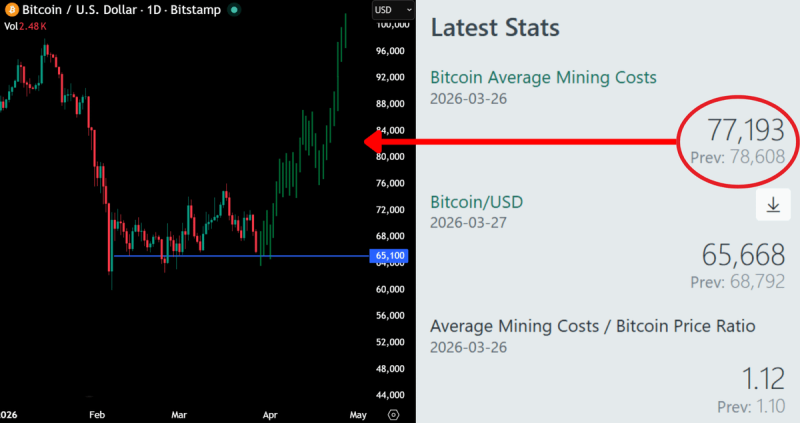
That does not guarantee an immediate upside breakout, but it does change the supply picture. When production economics deteriorate, weaker operators tend to reduce output, sell less aggressively, or shut down less efficient machines. Hashprice at $33.65 per PH/s per day and a 7.76% drop in mining difficulty both fit the broader picture of tightening miner margins.
When production economics deteriorate, the supply picture changes - weaker operators reduce output and shut down less efficient machines.
BTC Hovers Near $80K as Miner Stress Signals Potential Local Bottom tracked an earlier stage of this same dynamic, when miner stress was just beginning to show up in the data.
Why the $65K Zone Suddenly Carries More Weight for BTC
The chart strengthens that argument. Bitcoin fell hard, then built a base around the horizontal level near $65,100 before reversing higher. That level now stands out as the line that changed the tone of the market. Instead of making fresh breakdown lows, BTC began printing a firmer recovery structure and then accelerated sharply into late April on a series of strong green candles.
This is not a low-volatility grind higher - it is a forceful repricing attempt from a level the market repeatedly defended.
This is not a clean, low-volatility grind higher. It is a forceful repricing attempt from a level the market repeatedly defended. Once that base held, the structure shifted from unstable consolidation to breakout behavior - the market stopped acting like a weak trend and started behaving like a squeeze.
Bitcoin Mining Costs Jump to $75K-$138K Per Coin as Industry Faces Profitability Squeeze laid out the scale of the cost problem across the industry, showing just how wide the stress band has become for different types of mining operations.
Bitcoin Momentum Is Improving, but the Move Is Not Fully Settled
Even so, the setup is not risk-free. The left side of the chart shows BTC pushing into the upper-$90,000 area after a steep vertical advance, which means the market is no longer near the original support and is entering a zone where profit-taking can appear quickly. The speed of the recovery is bullish, but fast upside moves often invite volatility once initial buying pressure cools.
What makes this setup stand out is that the technical rebound is happening while the production-cost gap remains unresolved. If Bitcoin continues closing that gap, the move can extend aggressively - the market would be repricing toward a more sustainable supply backdrop.
But if momentum fades, traders will likely look back to $65,100 as the level that must hold to preserve the bullish structure. Bitcoin Eyes $58K Support Zone as 300-Week EMA Aligns with Production Cost outlines what the downside scenario looks like if that base gives way.
 Peter Smith