Victoria Bazir

Bitcoin's macro structure remains intact heading into this cycle, but the foundation beneath it is evolving. According to Crypto Rover, the estimated electrical cost of mining Bitcoin has dropped below $50,000 - a development that suggests the lower boundary of the market cycle is no longer rising the way it used to.
The Structural Role of Bitcoin's Cost Curve
The long-term chart presents Bitcoin trending upward across multiple cycles while a cost curve tracks the estimated electrical cost of production.
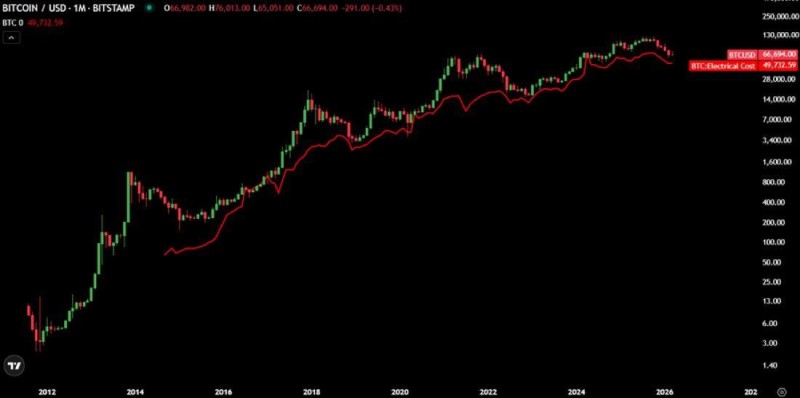
Historically, this baseline has acted as a dynamic floor for Bitcoin price behavior:
- During bear markets, price tends to approach or briefly dip near this level
- In recovery phases, price moves away while the cost curve gradually rises
- Over time, the upward slope of the curve reinforces a higher long-term base
What stands out now is that this relationship is changing. The cost curve is no longer trending sharply higher.
The estimated electrical cost of mining Bitcoin has dropped below $50,000 - a development that suggests the lower boundary of the market cycle is no longer rising.
Instead, it has flattened, with a slight downward tilt visible near the current period - a subtle but meaningful shift in the structural picture.
Bitcoin Mining Cost Gap Widens as Price Holds Mid-$60Ks
Bitcoin is currently trading around the mid-$60,000 range, while the cost curve sits notably lower. This creates a clear separation between market price and production cost. Bitcoin recently rejected near the $68,000 range high and continues to trade within a range, highlighting indecision at current levels.
Unlike previous cycles where price often interacted closely with this baseline, the current structure shows a wider margin:
- Price remains elevated relative to cost
- The cost floor is no longer catching up to price
- The distance between the two introduces a different support dynamic
What a Declining Bitcoin Cost Floor Signals for Long-Term Support
The key takeaway is not just that the cost has dropped below $50,000, but that the slope itself has changed. A rising cost curve typically signals strengthening structural support, while a flat or declining curve suggests that this support is stabilizing rather than expanding.
In practical terms, this means the floor beneath Bitcoin is no longer moving upward at the same pace. BTC may revisit lower support zones during consolidation phases before attempting further upside moves - a dynamic that aligns with broader technical expectations for this cycle.
The shift in the underlying cost curve introduces a quieter signal - one that suggests the long-term support structure is no longer strengthening, but holding steady at a lower trajectory.
For now, Bitcoin remains firmly above its production cost. But if price were to correct, the next meaningful interaction with this baseline would occur significantly lower than current levels. Bitcoin currently eyes the $69K target as the $68.4K support level defines the next move - a zone that will matter considerably more now that the structural floor beneath it is no longer climbing.
 Victoria Bazir