Marina Lyubimova

Palladium prices are holding steady around the $1,679 level as traders watch for the next move in what's shaping up to be a critical moment for the precious metal. After getting pushed below its 50-day exponential moving average, the market is now sitting in a kind of limbo - caught between buyers defending support and sellers testing whether they can push things lower. The daily chart shows palladium moving within a rising broadening wedge that sits inside a larger ascending channel, which basically means volatility is picking up and the market is getting less predictable.
Rising Channel Structure Shows Market Indecision at $1,679
The bigger picture here is that palladium has been trading in a rising channel for months now, and within that channel, a broadening wedge pattern has formed. This wedge is one of those technical setups where price swings start getting wider and wider, showing that buyers and sellers are becoming more aggressive but can't quite agree on direction. It's the kind of pattern that typically shows up when markets are transitioning - when a strong trend starts losing steam and consolidation takes over. Recent analysis discussing palladium forms cup pattern near $1,845 as price stabilizes highlighted similar volatility after earlier rallies, and the metal has been swinging sharply ever since.
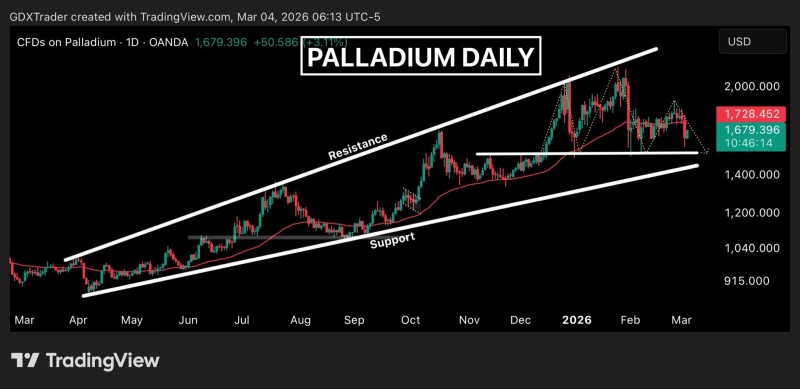
After that bearish candle broke below the 50 EMA, the next session produced what traders call an inside-range candle - basically a smaller candle that fits entirely within the previous day's range. That's usually a sign that momentum is pausing and traders are taking a breath before deciding what comes next. Some technical analysts are watching for a potential head-and-shoulders topping pattern if the right shoulder forms and price eventually cracks below support. Market commentary on palladium bear flag at $1,600 support points to $1,350 risk reinforces how important these support levels are in determining where palladium heads from here.
Key Support at Channel Base Could Determine Next Trend Phase
Right now, palladium is sitting at a make-or-break spot. Buyers are defending the bottom of that rising channel while sellers keep probing to see if they can break through. Commodity markets like palladium tend to be extra jumpy because they're so sensitive to shifts in industrial demand, supply disruptions, and broader economic conditions. For anyone wondering what are tradable commodities and why metals like palladium matter, it's this industrial importance that makes them swing so sharply compared to other assets. As long as that lower channel boundary holds, the overall structure stays intact, and the market remains balanced between consolidation and a possible reversal. If support breaks, though, things could get interesting fast.
 Marina Lyubimova