Usman Salis

A wave of strikes across the Middle East has severely disrupted energy infrastructure, removing a meaningful share of global supply and exposing critical vulnerabilities in oil transport and processing networks. As Global Markets Investor noted, the scale of the damage suggests the market is no longer dealing with isolated incidents but a broad systemic shock.
The Infrastructure Map That Shows the Oil Shock Scale
The map highlights a wide geographic spread of damaged assets, stretching across key production and export corridors in the region. Oilfields, refineries, ports, and pipelines appear simultaneously affected - pointing to a coordinated disruption rather than localized outages.
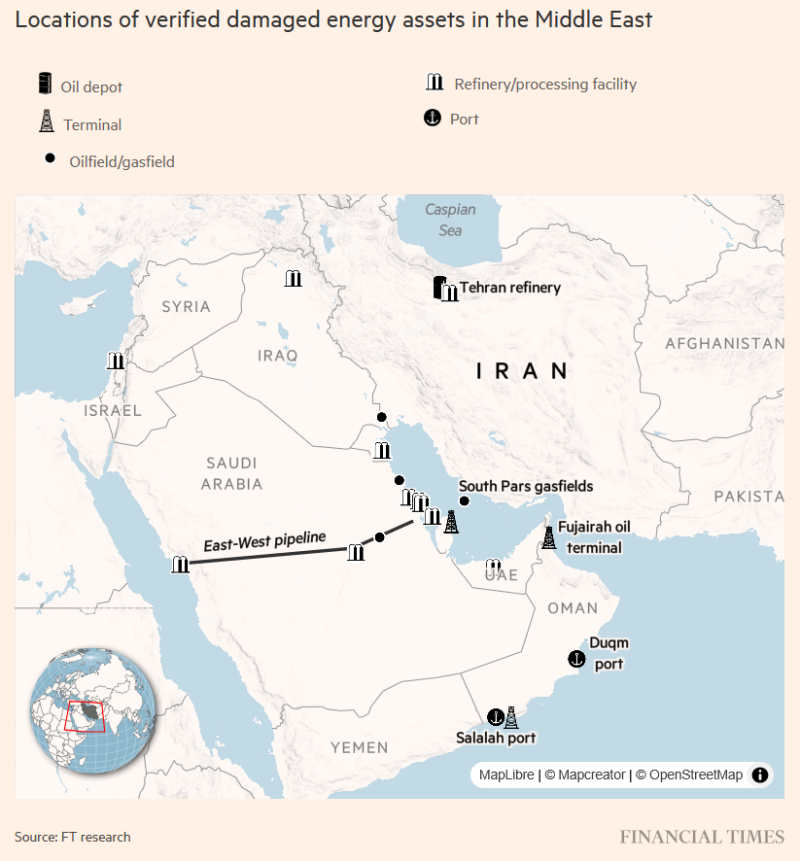
Several critical nodes stand out, including major refining hubs, gas fields, and export terminals across Saudi Arabia, Iran, Qatar, and the UAE. The East-West pipeline - an essential route designed to bypass the Strait of Hormuz - is also shown within this network, reinforcing how deeply the disruption cuts into the redundancy systems that markets typically rely on during single-point failures.
Oil Supply Losses Are Structurally Significant
The figures point to a substantial contraction in available supply. Saudi Arabia alone has seen production capacity reduced by hundreds of thousands of barrels per day, while the disruption extends well beyond crude production. Refining capacity across the region has also been affected, alongside LNG infrastructure in Qatar where a significant portion of export capability has been taken offline.
The scale across the full chain is what distinguishes this from a routine supply disruption:
- Around 10% of global crude production remains offline
- Millions of barrels per day are impacted across production and refining
- Key export routes face ongoing constraints
WTI Oil Surges Above $101 as Iran Deadline Drives $100 Break captured the initial price response as the scale of disruption became clear - showing how quickly the market moved to reprice once supply loss figures began to circulate.
The Oil Network That Cannot Fully Compensate
Even though some capacity has been partially restored - including Saudi production and pipeline throughput - the broader network remains impaired. Storage buffers and alternative routes have helped maintain flows in the short term, but they do not replace lost production or refining capacity.
WTI Crude Oil Spikes to $110-$120 as Strait of Hormuz Closes shows how the closure of key transit routes has amplified the supply shock beyond what production losses alone would suggest - with transport constraints layering on top of output reductions across the same timeframe. WTI, Brent Diverge as Asia Oil Prices Surge Above $150 reflects how differently regional markets are absorbing the shock, with Asian buyers facing the most acute price pressure as Middle East supply routes remain constrained.
 Usman Salis