Usman Salis

⬤ Gold recently broke out of a tight consolidation zone that had formed along the lower boundary of a larger ascending broadening wedge. The breakout came after XAU compressed into a narrow range for several sessions, building pressure before the upward move. The metal shifted from sideways price action into a rising pattern while staying inside the broader expanding structure that's been developing over recent months.
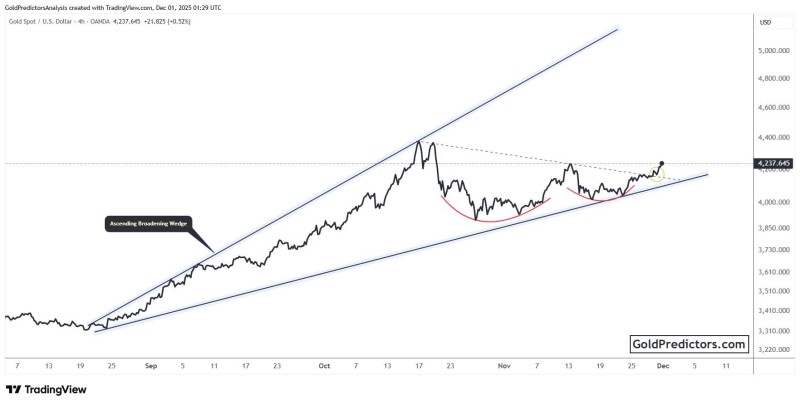
⬤ The chart reveals the wider wedge formation, marked by two diverging trendlines that frame gold's longer-term path. Inside this structure, a double-rounded base took shape near the lower support line, showing two curved troughs that typically signal weakening downside pressure before momentum builds. Before the latest move, gold formed progressively higher lows with tightening volatility, creating the foundation for the current upward push.
⬤ A minor descending trendline from mid-November had previously capped short-term gains, but gold's recent advance carried it past that resistance level. This signals a shift in near-term behavior while the metal continues to respect the boundaries of the larger wedge. The price has maintained a constructive position above key support areas that have guided its trend since early autumn, despite earlier pullbacks.
⬤ This movement matters in the broader market context because gold remains a major reference point during periods of economic uncertainty. When XAU transitions from consolidation into upward movement within a clear technical framework, it tends to influence sentiment across both safe-haven assets and inflation-sensitive sectors. The combination of the double-rounded base and the preserved ascending formation gives traders a defined technical structure for evaluating gold's behavior as market conditions continue to develop.
 Usman Salis