Eseandre Mordi

The GDX Gold Miners ETF is flashing a rare extreme breadth reading, with the advance-decline percentage falling to -100%. That means every tracked component inside the index is declining at the same time. Such full downside breadth events have historically been short-lived, often followed by a recovery as selling pressure begins to stabilize.
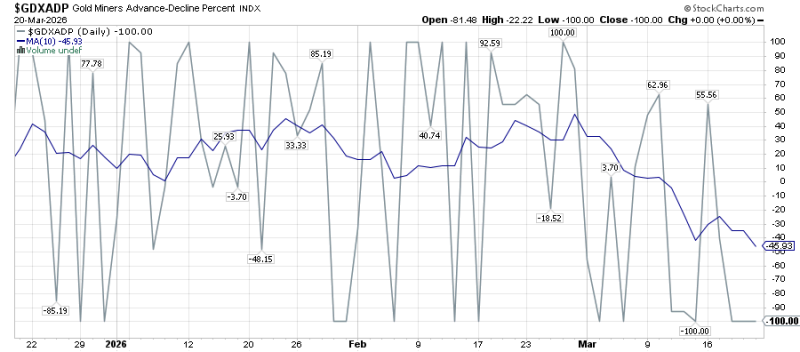
The advance-decline indicator has swung sharply between positive and negative extremes multiple times in recent history. But the current move to -100% is distinct: it reflects maximum participation in the selloff, not a partial rotation. The indicator's moving average has also turned lower and is now deep in negative territory, confirming that internal weakness has been building rather than spiking in isolation.
Market breadth works by comparing the count of advancing stocks against declining ones within a given index. When that ratio hits the floor at -100%, it signals a synchronized move rather than isolated pockets of weakness. Historical chart data shows this level has appeared before, typically acting as a short-term compression point ahead of a breadth rebound.
For traders watching GDX price action, extreme breadth readings like this one highlight how selling pressure can become uniformly distributed across components. Internal indicators reaching compressed levels during sharp declines tend to influence short-term sentiment dynamics and are worth monitoring closely for early signs of stabilization.
 Eseandre Mordi