Marina Lyubimova

Copper is no longer just a cyclical industrial metal. For a growing number of market participants, it's becoming a strategic asset, and Friday's price action made that case hard to ignore.
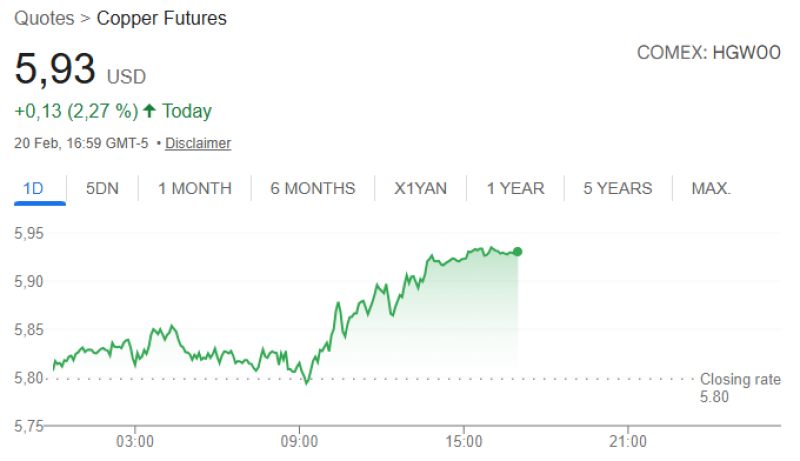
HG copper futures settled near $5.93 after rallying roughly $0.13, or 2.27%, from an intraday base around $5.80. The move was steady and sustained, not a spike, which gave bulls more confidence that the day's gains had real conviction behind them.
Why Copper Is Attracting Long-Term Buyers
Analyst and commentator Alex Mason drew attention for publicly shifting away from Bitcoin positioning and into physical copper, describing multi-tonne purchases and calling the metal a scarcity asset tied to future infrastructure rather than a short-term trade.
This isn't a trade. It's a multi-year positioning play on the physical world's most essential industrial metal.
The thesis rests on three pillars. First, the AI energy shock: data centers require massive upgrades in power delivery, cooling, and wiring. The existing grid cannot absorb the projected load without significant expansion, and copper is central to every layer of that buildout. Second, electrification: an EV uses roughly 80kg of copper versus 23kg in a conventional gas car, and wind and solar buildouts are similarly copper-heavy. Third, and perhaps most critically, supply. New major mines are scarce, permitting to production timelines run 17 to 20 years, and ore grades are declining.
The 2040 Deficit and What It Means for Prices
The numbers behind the supply story are striking. A projected 10-million-tonne annual copper deficit by 2040 implies a structural gap that could fundamentally reprice the metal if demand continues to accelerate while new supply fails to keep pace.
That backdrop is what turned Friday's 2.27% session gain into something traders are watching closely. It's not just momentum. It's the market beginning to price in a longer narrative. Technical analysts are already flagging key levels, with some pointing to a potential Wave 4 correction after copper's push toward $6.00, suggesting the near-term path may not be straight up even if the long-term thesis holds.
The real question isn't whether copper demand will rise. It's whether supply can respond fast enough, and right now, the evidence suggests it can't.
 Marina Lyubimova