Marina Lyubimova
⬤ NIO's smart electric vehicle business got a meaningful capital injection as its subsidiary Shenji closed definitive agreements with Chinese investors for a RMB2.257 billion investment. NIO sold a 27.3% equity stake in Shenji - the unit focused on intelligent-driving chips - while holding on to a controlling 62.7% interest. The deal, announced February 26, 2026, involves newly issued shares purchased in cash and remains subject to standard closing conditions.
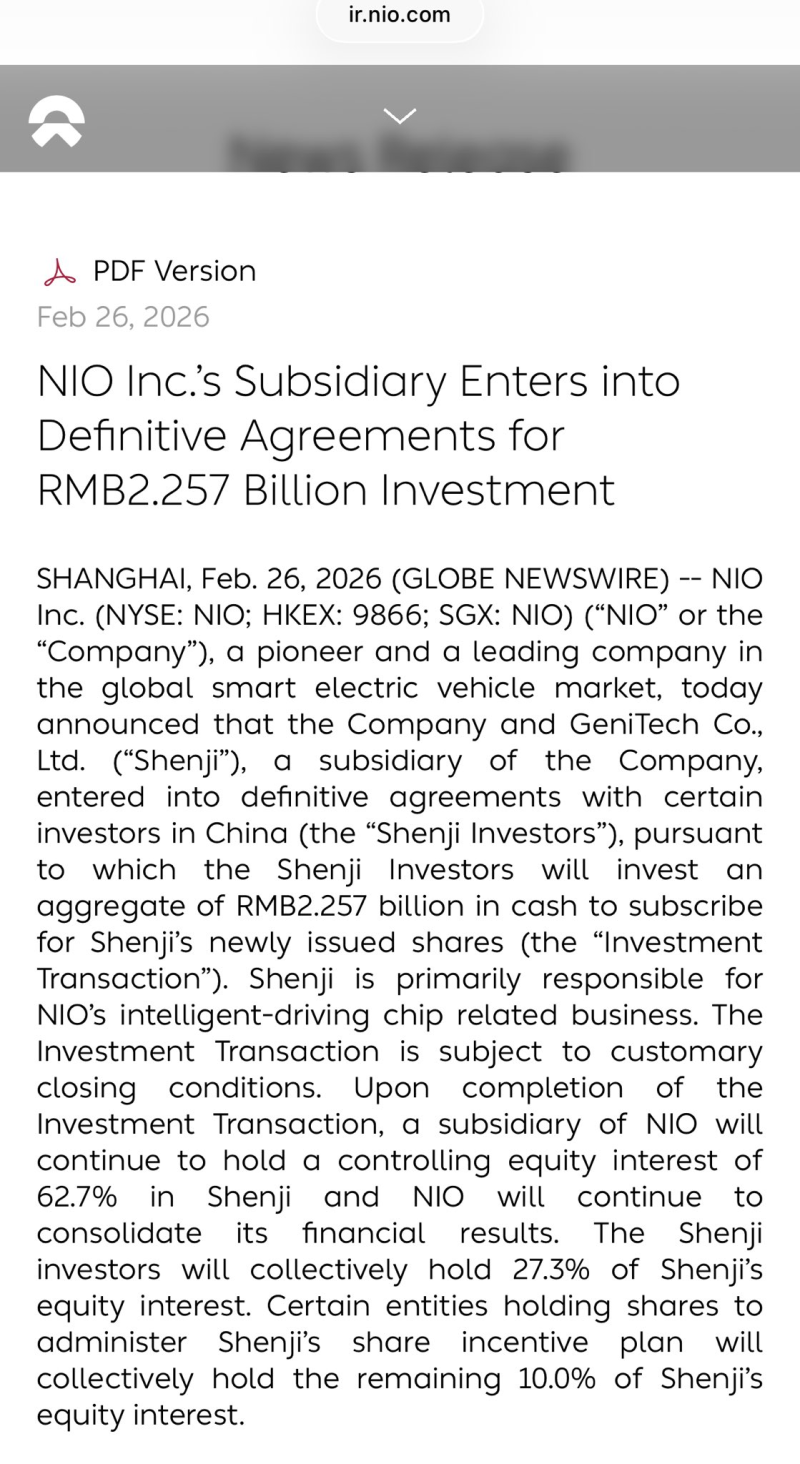
Shenji is the core of NIO's autonomous driving chip business. Once the investment closes, NIO's subsidiary will hold 62.7%, the Shenji Investors will collectively own 27.3%, and share-incentive plan entities will account for the remaining 10.0%. The capital is earmarked to accelerate Shenji's development and fund the intelligent driving chip operation directly - without touching NIO's corporate ownership structure. It's a clean way to bring in outside money while keeping strategic control exactly where NIO wants it.
The move speaks to NIO's broader push into in-house semiconductor development - an area that's become a real differentiator in a crowded EV market. External investors backing Shenji signals genuine confidence in NIO's chip ambitions and reflects the wider market appetite for autonomous driving technology. Analysts tracking NIO's technical setup have pointed to a bull flag pattern signaling an $8.64 breakout target, suggesting the market is watching the company's technology bets closely. NIO's strategy has clearly evolved beyond vehicle production into owning the key tech stack underneath it.
Pulling in RMB2.257 billion at the subsidiary level is a notable win for NIO. It addresses funding needs, reinforces the chip roadmap, and extends operational runway - all without giving up majority control. With GIC's exit still fresh in investor memory and speculation about a return circulating, this deal adds a layer of financial stability at a critical moment. As EV companies increasingly compete on software and autonomy rather than just hardware, subsidiary-level capital raises tied to technology units may become a go-to playbook across the industry.
 Marina Lyubimova