
 Marina Lyubimova

Women's presence in science and engineering is no longer a footnote in Europe's labor market story. According to Eurostat's 2024 data, 7.9 million women work as scientists and engineers across the European Union, making up a significant share of STEM employment in a region that increasingly depends on technical talent to power its economy. But the headline number only tells part of the story, because behind that figure lies a patchwork of regional realities that vary dramatically from one corner of Europe to another.
Canarias Tops 58.8%, Central Europe Trails Behind
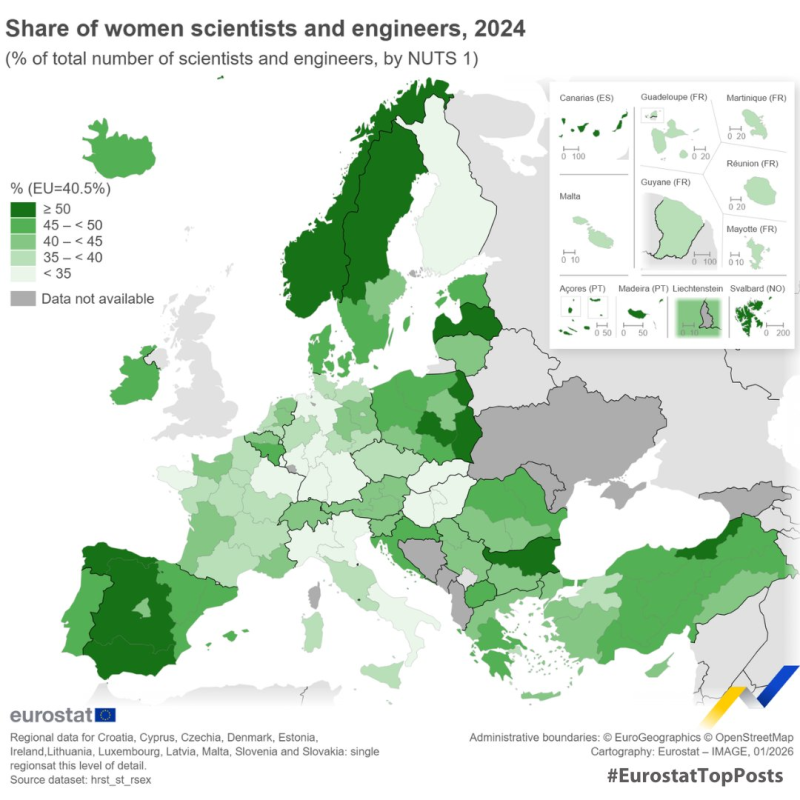
The EU-wide average sits at roughly 40.5% female representation in science and engineering roles, but individual regions diverge sharply from that midpoint. Canarias, Spain's Atlantic archipelago, leads all regions at 58.8%, a figure that places it well above the continental norm. At the other end of the spectrum, Hungary's Kozep-Magyarorszag records the lowest share at 30.0%, highlighting a persistent East-West split that shows up across the Eurostat map's color gradients.
Regional differences underscore persistent disparities that may influence future efforts to promote equitable access to technical careers across member states.
Western and Northern European regions generally clear the EU average, while many Central and Eastern European territories lag behind, suggesting that geography, education systems, and labor market structures all play a role in shaping who ends up in a lab or an engineering firm.
What 7.9M Women in STEM Signals for Europe's Economic Future
Science and engineering roles sit at the heart of the sectors driving Europe's growth: digital industries, advanced manufacturing, and research-intensive fields where the next decade's competitive edge will be built. A high female share in these professions points to real progress in opening up fields that were historically male-dominated. It also carries economic weight. Broader participation in technical careers expands the talent pool available to employers and strengthens the case for investing in STEM education pipelines that reach girls and young women early.
Earlier EU labor market coverage from The Tradable revealed that 1.3 million workers in transport alone are employed by foreign-controlled firms, a reminder of how deeply integrated and talent-dependent European industries have become. The regional gaps visible in the Eurostat data are worth watching closely, since closing them is as much an economic competitiveness question as it is a gender equity one.
Policy efforts around education access and youth employment, where the EU already shows wide national variation, will likely determine whether the 7.9 million figure grows meaningfully in the years ahead. As disability gap data in EU education has shown, structural inequities in how people access learning and careers rarely resolve on their own.
 Marina Lyubimova



