Saad Ullah

Europe's retirement income divide is still very much alive. According to Eurostat's latest figures, women aged 65 and over in the EU received pensions that were 24.5% lower on average than men in 2024 — a gap that varied enormously depending on where in the bloc you happened to retire.
Malta at 40.3% and the Netherlands at 36.3% Lead the Gap
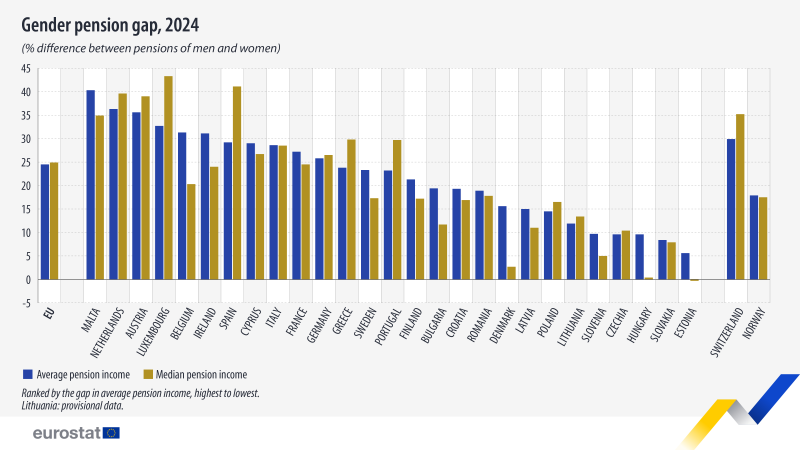
The country-by-country breakdown reveals just how uneven retirement outcomes are across the EU. Malta recorded the highest gender pension gap at 40.3%, with the Netherlands close behind at 36.3%. Both figures stand well above the bloc-wide average, and they reflect structural differences in how women have historically participated in the labor market in those countries. Eurostat's chart compared results using both average and median pension income, showing that the distribution of retirement income within a country can shift the reported gap even when the overall direction stays the same.
The scale of the gender pension gap adds a concrete benchmark to discussions around inequality, retirement adequacy, and structural labor-market outcomes that can influence policy priorities across the EU.
For context, TheTradable has been tracking related EU social indicators, including EU Data Reveals 3.2% of Children Face Unmet Healthcare Needs in 2024, which draws on similar Eurostat datasets to map welfare gaps across the region.
Estonia at 5.6% and Slovakia at 8.4% Show a Different Path Is Possible
At the other end of the scale, Estonia came in at just 5.6% — the lowest gender pension gap in the EU — while Slovakia followed at 8.4%. These figures suggest that with the right labor market and pension system structures, the gap can be kept significantly narrow. The contrast with Malta and the Netherlands is striking and raises obvious questions about what policy levers actually work.
The 2024 data also matters beyond social policy. Demographic pressures and social spending debates are increasingly shaping Europe's longer-term economic outlook, touching everything from fiscal planning to consumer resilience. A pension gap of nearly one in four euros is not just an equality issue — it feeds directly into how households spend, save, and age. Readers interested in broader EU demographic trends can also explore 25.4% of Young Europeans Work While Studying and EU Education Data Shows Sharp Disability Gap for related context on how structural inequalities show up across different life stages.
 Saad Ullah