Peter Smith

⬤ The Dollar is in a steady slide against emerging market currencies, and the policy divide it is exposing is getting harder to ignore. Brazil and Mexico are simply letting their currencies climb as the Dollar retreats, while China, Korea, Thailand, Taiwan, and Chile are actively building foreign reserves to keep appreciation in check. Charts pairing exchange-rate moves with reserve data across multiple EM economies make this split strikingly visible.
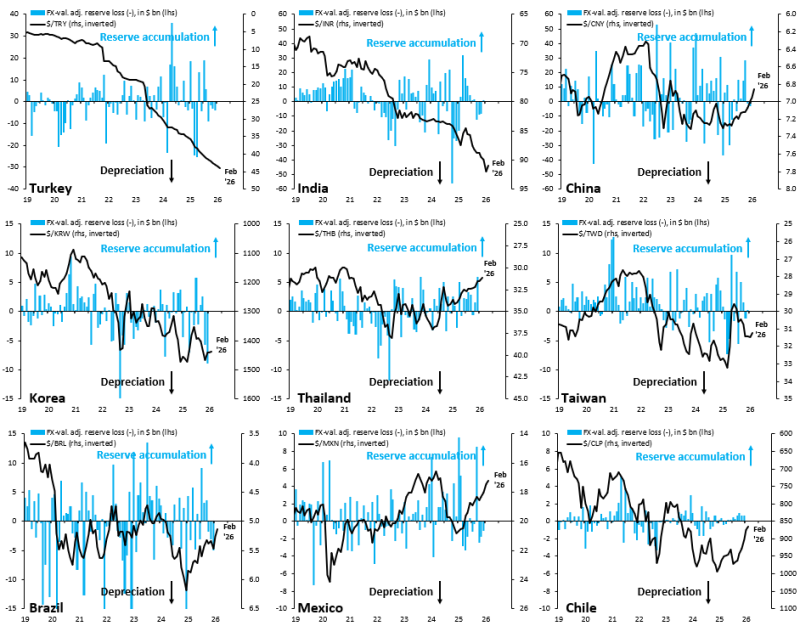
⬤ In the panels for the five intervening countries, "reserve accumulation" is flagged directly alongside inverted FX lines, and the latest February 2026 data points show the trend continuing. Rising reserves paired with restrained currency gains is a classic intervention fingerprint, suggesting authorities are managing the pace of appreciation rather than letting markets run freely. The DXY dropping below multi-decade support at the 95 zone has clearly added urgency to those decisions.
Some countries are tolerating a stronger currency, while others are smoothing or capping appreciation through reserve dynamics.
⬤ Brazil and Mexico tell a different story. Their panels lack the sustained reserve-accumulation signal seen in Asia and Chile, consistent with a hands-off approach that allows market forces to drive currency strength. It is a clean contrast: two camps inside EM FX, shaped entirely by how much each country wants to compete on exchange-rate terms in a weaker-Dollar world. The broader backdrop matters here too, as the US Dollar Index recently dropped 1% as 14-year support broke, amplifying pressure on every EM central bank to pick a side.
⬤ The stakes go beyond currency charts. FX policy choices feed directly into trade competitiveness, capital flows, and broader financial conditions. If the Dollar keeps softening while reserve accumulation persists across key Asian and LatAm economies, the gap between market-driven and policy-managed exchange rates will only grow, and that gap will shape the next phase of EM performance and cross-border capital trends.
 Peter Smith