Saad Ullah

Argentina has been one of the most closely watched fiscal stories in the world over the past few years. State-run companies hemorrhaging cash, a deficit financed through money printing, and an economy stuck in a cycle of inflation and instability. But recent data suggests something is changing. The public enterprise deficit, once running at roughly $14 million per day in early 2023, has now fallen below the $1 billion mark. That's a shift worth paying attention to.
From $5.71 Billion to $966 Million: A 3-Year Fiscal Swing
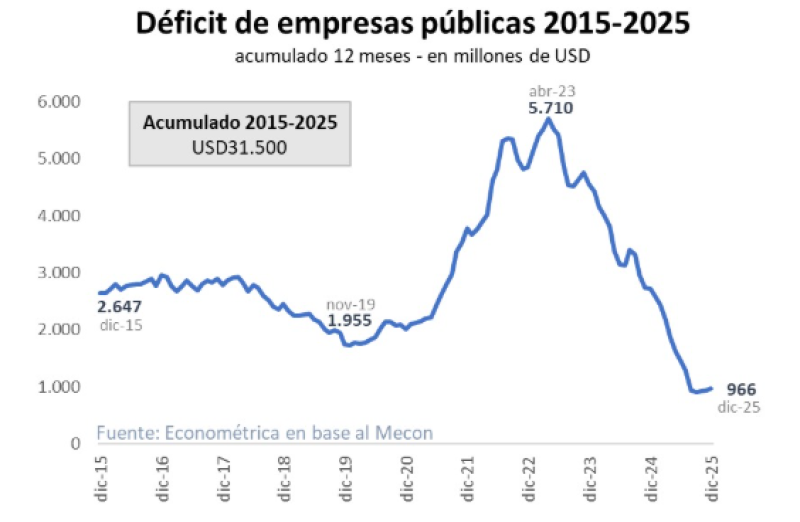
The chart "Deficit de empresas publicas 2015-2025" paints a clear picture. The 12-month accumulated deficit in USD hit $5,710 million in April 2023, the highest point in a decade. For context, the same metric stood at $2,647 million in December 2015 and $1,955 million in November 2019. The losses grew again between 2021 and 2023, driven by state companies operating at a loss while the government covered the gap through debt and monetary issuance. That deficit equated to 0.6% of GDP in 2023 alone.
During the first half of 2023, public companies managed by the National State were running operating losses of about $14 million per day.
By December 2025, the number had dropped to $966 million, breaking below the $1 billion threshold. The cumulative total across the full 2015-2025 period adds up to $31.5 billion. The broader inflation context behind this shift has been covered in depth, including the analysis in Argentina's Inflation Miracle: Milei's Shock Therapy Actually Works, which examines how the current administration's aggressive fiscal policies have started to produce measurable results.
Why the $966 Million Figure Matters for USD Stability and Macro Sentiment
State company losses don't exist in a vacuum. They feed directly into the overall fiscal balance, drive financing needs, and affect how global investors read Argentina's macro story. A deficit of $5.71 billion signals an economy where the government plugs holes with printed money. A deficit of $966 million suggests something structurally different is happening. For a broader view on how inflation dynamics play into this globally, Global Inflation 2020-2025: Why Investors Can't Ignore It puts Argentina's situation into an international frame.
Argentina has frequently appeared as a reference case in comparisons with other high-inflation economies. Turkey Inflation Surges: Second Highest in G-20 uses Argentina as a benchmark when measuring extreme inflation environments. That context makes the fiscal deficit data more significant: Argentina is no longer just a cautionary tale. The numbers are starting to tell a different story.
Whether the improvement holds will depend on a range of political and economic variables. But the move from $5.71 billion to $966 million in the accumulated 12-month deficit is a concrete, measurable shift, and one that reshapes how analysts and investors interpret Argentina's fiscal trajectory heading into 2026.
 Saad Ullah