Saad Ullah

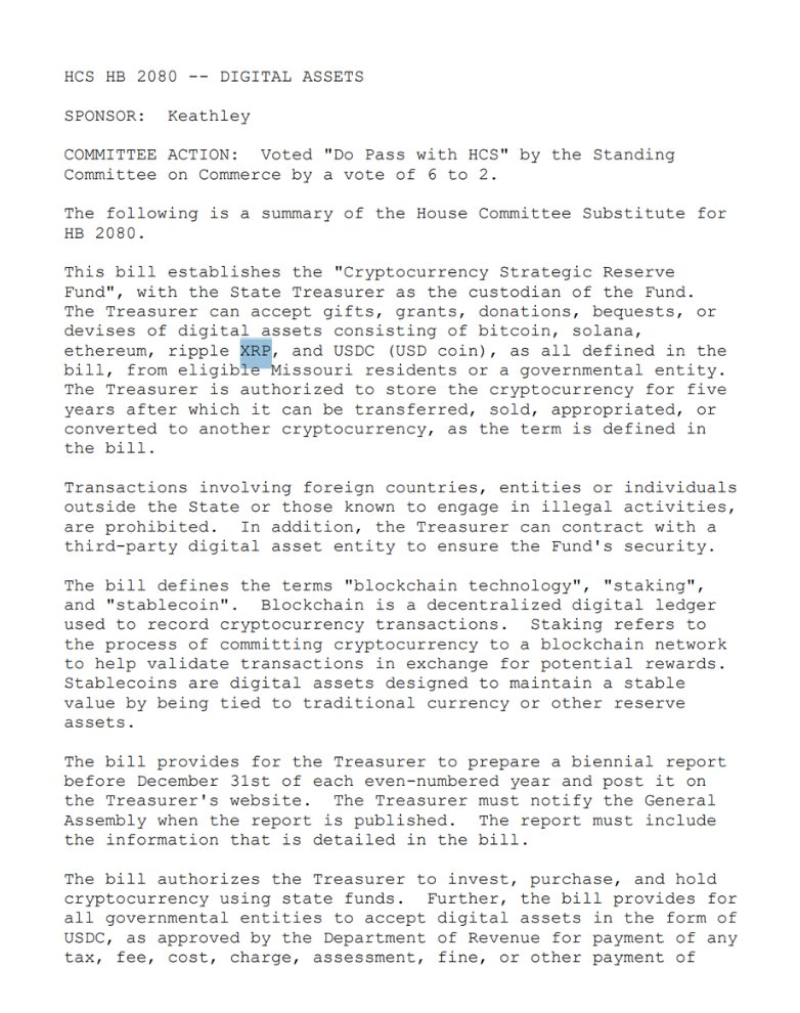
Missouri's House Committee on Commerce voted 6 to 2 to advance HB 2080, a bill that would create a "Cryptocurrency Strategic Reserve Fund" and formally recognize XRP as an eligible state-held digital asset. The move places XRP alongside Bitcoin, Ethereum, Solana, and USDC in a proposed public reserve structure, marking one of the more concrete examples of XRP entering U.S. state-level financial legislation.
What HB 2080 Actually Allows: 5-Year Holdings and Third-Party Custody
Under the bill, Missouri's State Treasurer would serve as custodian of the fund and could accept digital assets through gifts, grants, or donations. Assets like XRP may be held for up to five years before being transferred, sold, or converted. The bill stops short of assigning XRP a unique legal status, treating it as part of a diversified reserve basket rather than a standalone holding. Ripple's U.S. Banking License Under Review: XRP Implications provides further context on the regulatory backdrop shaping such moves.
Broader XRP Integration Signals Growing Institutional Momentum
HB 2080 also authorizes third-party custody providers to secure holdings and defines key industry terms including blockchain, staking, and stablecoins. Government entities would be permitted to accept USDC for payments. Restrictions on transactions involving certain foreign entities are also included. For context on parallel institutional interest, XRP Price Prediction: $208B New York Pension Fund Increases XRP Exposure by 543% underscores the scale of growing XRP adoption across public sector entities.
While HB 2080 has not yet become law, its 6-2 committee vote signals real legislative traction. The bill reflects a broader pattern of U.S. states moving to define how cryptocurrencies can be held and managed within public financial systems. As Ripple USD News: Treasury's Stablecoin Crackdown Could Be XRP's Golden Ticket outlines, regulatory developments at both state and federal levels are converging around XRP's role in institutional finance.
 Saad Ullah