Usman Salis

Palladium is slipping deeper into bearish territory as recent price action confirms a structural breakdown, with buyers repeatedly failing to regain control. What initially looked like consolidation has turned into continuation, as the market drifts lower beneath key trend levels.
Palladium Breaks Rising Support as Bearish Palladium Structure Takes Hold
The chart shared by @Trader highlights a critical transition in palladium's structure. Price has broken below the rising support trendline that defined the broader uptrend, effectively ending the sequence of higher lows.
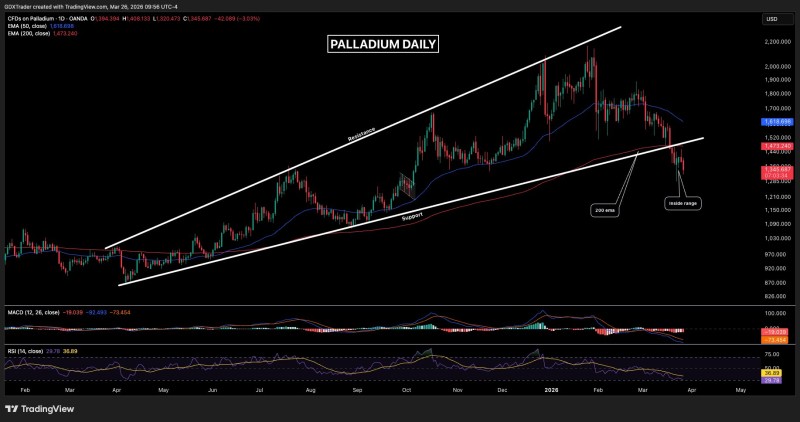
This breakdown is subtle but decisive. Rather than a sharp collapse, the market is showing a controlled deterioration - a pattern often associated with sustained bearish phases. The former support zone is no longer attracting buyers, signaling a clear shift in control toward sellers.
Rather than a sharp collapse, the market is showing a controlled deterioration - a pattern often associated with sustained bearish phases.
A key moment came with the inside range candle, which typically reflects consolidation before expansion. But the expected bullish resolution never showed up. Price failed to break above the mother bar high, buyers showed no follow-through, and a bearish continuation candle followed. This sequence aligns with @Trader's interpretation: a failed bullish trigger that reinforced the prevailing trend. In technical analysis, failed setups like this often carry more weight than successful ones - they reveal underlying weakness in demand.
Moving Averages Confirm Palladium Weakness Below Key Levels
The positioning of moving averages adds another layer of confirmation. Palladium is now trading below the 50 EMA, testing the 200 EMA from above and beginning to slip beneath it, while facing downward-sloping dynamic resistance at every turn.
The 200-day moving average, which previously acted as support, is now at risk of flipping into resistance. Once price accepts below this level, rallies tend to get capped more aggressively. This aligns with broader commodity behavior, where breakdowns below key moving averages often lead to extended downside phases. Similar structures have been observed in recent palladium setups, where weakening momentum near wedge formations preceded further declines.
The 200-day moving average, which previously acted as support, is now at risk of flipping into resistance.
Palladium Price Action Shows Bounce Attempts Getting Sold
Momentum indicators reinforce the bearish structure. RSI is trending lower without meaningful divergence, while MACD remains in negative territory, signaling persistent downside pressure.
The price structure itself tells the same story:
- Lower highs forming after rejection near the upper range
- No confirmed higher low
- Continued rejection near moving averages
This creates a clear behavioral pattern: bounce attempts are being sold into rather than accumulated. Recent analysis of palladium price action also pointed to fading momentum near key support zones, with bearish continuation following indecision candles - a pattern now repeating.
Bounce attempts are being sold into rather than accumulated.
Palladium is now trading in a technically fragile state, where structure, momentum, and positioning all favor sellers. Until the market can reclaim broken support levels and establish a confirmed pivot with strong follow-through, downside pressure is likely to persist.
 Usman Salis