Marina Lyubimova
China's urban energy landscape has undergone a massive transformation as hundreds of millions of households gain access to pipeline natural gas. The shift away from coal-based fuels and bottled gas marks one of the largest residential energy transitions in modern history, reshaping both domestic consumption and global fuel markets.
Urban Gas Coverage Nearly Triples in 14 Years
China has connected more than 300 million additional people living in urban households to natural gas since 2010. The rollout reflects a sustained policy push to replace higher-polluting fuels used for cooking and heating in cities.
The chart shows the number of urban residents with access to natural gas climbed to 484 million by the end of 2024, up from about 170 million at the end of 2010—a net increase of roughly 314 million people. While the expansion remains substantial, the pace has cooled compared with the mid-2010s: new additions now run at around 13–15 million people per year, down from 20–30 million earlier in the buildout.
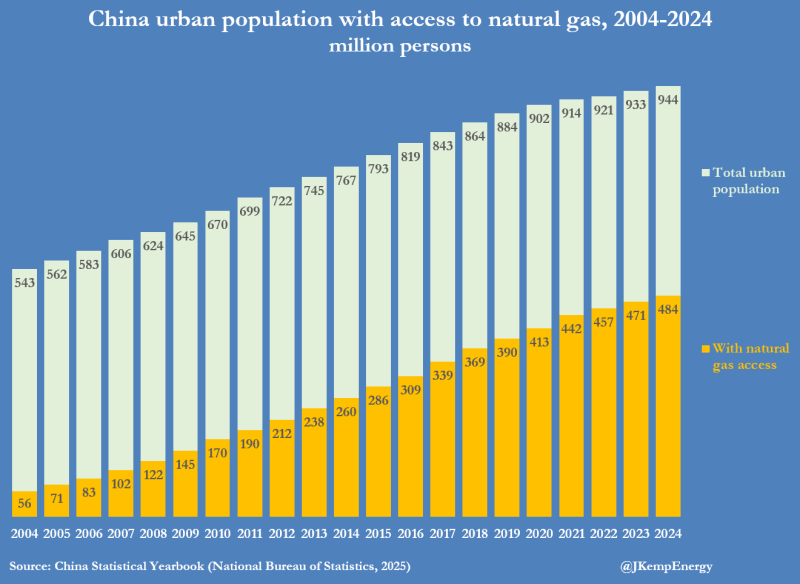
The proportion of urban households with natural gas service roughly doubled to about 51% in 2024 from around 25% in 2010, showing expanding coverage even as overall urban population growth slows.
From Coal Gas to Pipeline Networks
The transition involved a fuel switch within "gas supply" itself. Many urban households previously relied on gasworks gas made from coal or bottled liquefied petroleum gas before progressively moving toward pipeline-delivered natural gas through local distribution networks.
This buildout sits alongside broader changes in China's energy system, including shifting generation and fuel mix dynamics.
Impact on Energy Markets
The expansion matters for energy markets because rising household access drives structural demand for distribution infrastructure and supply. At the same time, natural gas pricing remains sensitive to broader market conditions, as seen when natural gas tested $3 support after an 8% drop.
 Marina Lyubimova