Eseandre Mordi

Amazon's stock took a notable hit this week as reports emerged of physical disruptions to its cloud infrastructure in the Middle East. For investors watching AWS as Amazon's most profitable business segment, headlines about regional outages tend to land hard, and this one was no exception.
2 AWS Zones Offline: What Happened in the Middle East
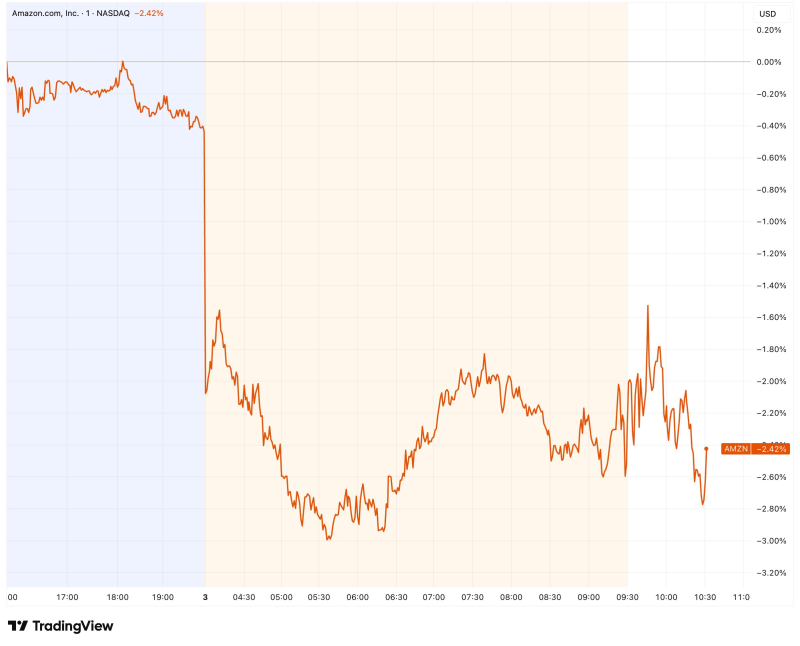
Drone strikes reportedly knocked out two of three AWS Availability Zones in the UAE and Bahrain, triggering service disruptions across EC2, S3, and Lambda. AMZN Stock Bounces Back After AWS Outage coverage from TheTradable shows this is not the first time cloud uptime events have moved the stock, but the scale of this incident caught the market's attention. Intraday charts showed AMZN down roughly 2.42%, consistent with market commentary putting the decline at around 2.5%.
Beyond the initial strike damage, recovery was slower than expected. Fire-suppression systems activated during the incident caused water damage that added another layer of complexity to restoration efforts.
Recovery was more complex due to fire-suppression water damage, raising questions about how quickly normal operations can be restored.
AWS advised customers to migrate workloads away from the affected regions while engineers worked through the issues, though no clear timeline for full restoration was immediately available.
Market Reaction and What It Means for AWS Cloud Revenue Exposure
Service interruptions involving EC2, S3, and Lambda carry outsized weight in market sentiment because these products underpin enterprise workloads and application infrastructure globally. The intraday price action reflected a sharp drop followed by choppy stabilization, a pattern consistent with investor uncertainty about outage duration and downstream effects. AMZN Stock Holds Strong Despite AWS Downtime is another case where similar dynamics played out, reinforcing the pattern investors now associate with these events.
If customers manage to reroute workloads successfully, near-term financial impact may be contained. But prolonged outages or a broader erosion of enterprise confidence could keep AMZN sentiment under pressure. Investors are also watching how this factors into AWS growth expectations, a theme explored in AWS Growth Poised for Strong Rebound with Anthropic Clusters. The episode reinforces how operational resilience and regional redundancy have become central to cloud market confidence, and why AWS reliability headlines move markets the way they do.
 Eseandre Mordi