Editorial staff

Interest in crypto payments has grown steadily in recent years, driven by higher transaction speeds, global accessibility, and the rise of stablecoins that help reduce exposure to volatility. In this evolving landscape, some businesses have explored crypto payment gateways with simplified onboarding processes.
As digital commerce expands and global customer bases grow, companies are increasingly looking for faster and more flexible payment solutions. While certain platforms aim to streamline user interactions and reduce operational complexity, compliance procedures such as KYC/KYB and AML checks remain an essential part of working with digital assets in most jurisdictions. As a result, businesses are focusing not only on efficiency, but also on building secure and well-structured payment infrastructures that balance usability, control, and regulatory alignment.
Growing Demand for Simpler Crypto Payment Solutions
Interest in crypto payments has grown steadily in recent years, driven by higher transaction speeds, global accessibility, and the rise of stablecoins that help reduce exposure to volatility. In this environment, some businesses have explored crypto payment gateways with more streamlined onboarding and integration processes.
Many companies aim to integrate cryptocurrency payments quickly while maintaining efficient user experiences. At the same time, non-custodial solutions - where businesses retain control over their own funds - have become increasingly attractive. These factors contribute to growing demand for solutions that are technically straightforward to implement, while also supporting secure transaction flows and enabling businesses to incorporate compliance procedures where required.
How Crypto Payment Gateways Work in Practice.
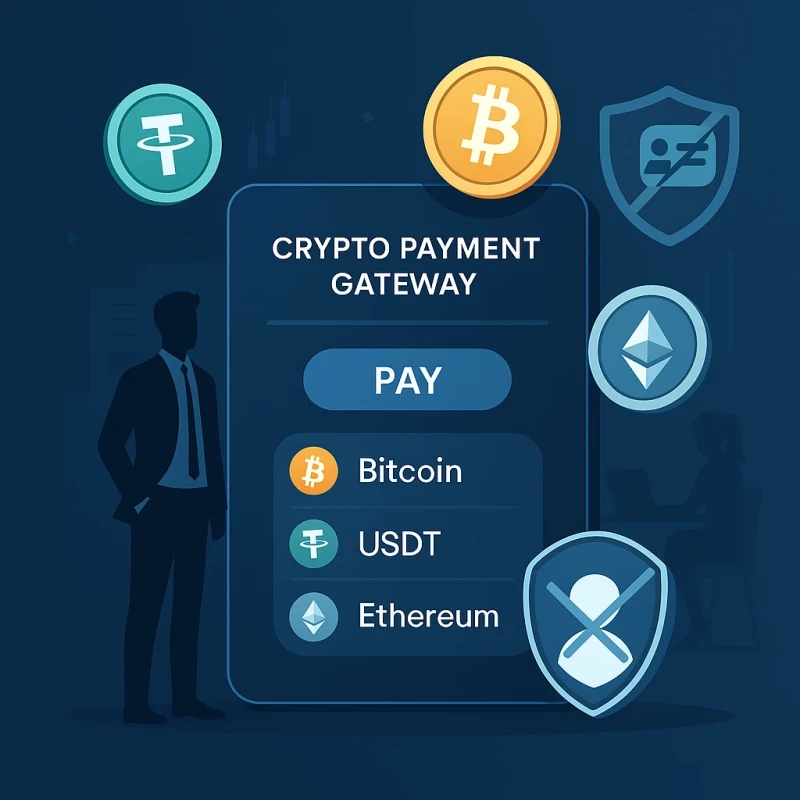
While the concept may sound unfamiliar to those used to traditional finance, the technical process behind such gateways is relatively straightforward. In many cases, these solutions operate using a non-custodial model, meaning the business retains control over its own funds rather than relying on a third party to hold them.
In practice, crypto payment gateways typically perform several core functions:
- generate a unique blockchain address for each payment;
- monitor incoming transactions on the blockchain;
- detect confirmations and update the order status;
- send automatic notifications via API or webhooks;
- support major cryptocurrencies such as BTC, ETH, USDT, USDC, and others.
At the same time, it is important to note that regulatory and compliance requirements—such as KYC/KYB and AML procedures—depend on the business model, jurisdiction, and the way the solution is implemented. Modern payment infrastructures are designed to give businesses flexibility in how they structure these processes, while maintaining secure, reliable, and well-controlled transaction flows.
Why Businesses Consider These Gateways
For companies operating across multiple regions, having a streamlined and flexible payment infrastructure can be a significant advantage. In this context, some businesses explore alternative crypto payment models as a response to challenges such as inconsistent banking infrastructure, slow international transfers, and varying regulatory environments.
When evaluating crypto payment solutions, companies typically focus on several practical factors:
- global accessibility for customers who prefer digital asset transactions;
- efficient and user-friendly payment flows;
- faster settlement compared to traditional banking systems;
- predictable transaction confirmation times on blockchain networks;
- the ability to diversify accepted payment methods.
At the same time, businesses must ensure that payment operations are structured in a way that aligns with applicable regulatory requirements and internal compliance policies. As a result, modern solutions are often designed to balance usability, security, and operational control, rather than focusing on any single aspect in isolation.
These types of infrastructures allow companies to integrate cryptocurrency payments into their existing workflows without significant disruption, making them suitable for e-commerce, subscription-based services, and platforms serving international audiences.
BitHide as an Example of Available Solutions
One example of a solution often considered in discussions around this type of infrastructure is BitHide, a self-hosted, non-custodial software designed for businesses working with crypto payments. The platform supports major cryptocurrencies including BTC, ETH, USDT, USDC, TRX, and BNB. Since BitHide operates as a non-custodial solution, businesses retain full control over their funds, data, and transaction processes.
BitHide’s system automatically tracks blockchain confirmations and sends updates to merchants, allowing businesses to verify transactions without manual monitoring. It also offers integration through a customizable checkout widget or API, enabling companies to incorporate crypto payments alongside their existing payment methods.
The solution is designed with a focus on security, automation, and operational flexibility. Where required, businesses can integrate compliance procedures such as AML transaction screening through third-party providers, depending on their specific regulatory and operational needs.
This approach demonstrates how modern crypto payment infrastructures can support efficient transaction processing while maintaining a high level of control, security, and adaptability.
Market Context and Shifting Preferences
Broader industry trends also contribute to the growing interest in alternative crypto payment infrastructures. As more users adopt digital assets, expectations around payment experiences continue to evolve, with increasing demand for both efficiency and secure transaction handling. At the same time, businesses are exploring more flexible payment architectures that can operate alongside traditional financial systems and support global operations.
The combination of non-custodial architecture, faster settlement times, and improved operational flexibility helps explain why different crypto payment models are attracting attention. At the same time, compliance requirements - such as KYC/KYB and AML procedures - remain an important consideration depending on jurisdiction and business structure. This shift reflects a broader movement toward more adaptable and technology-driven payment systems across the digital economy.
Conclusion
The growing interest in alternative crypto payment infrastructures highlights how businesses are adapting to new expectations around efficiency, speed, and global reach. These solutions provide a streamlined way to accept cryptocurrency while maintaining operational control and secure transaction management.
Platforms such as BitHide demonstrate how non-custodial, self-hosted software can support crypto payment operations by giving businesses full control over their funds, data, and transaction processes. At the same time, compliance requirements—such as KYC/KYB and AML procedures—remain an important consideration depending on the business model and jurisdiction.
As the digital payments landscape continues to evolve, demand is likely to grow for solutions that combine flexibility, automation, and security, allowing companies to integrate blockchain-based transactions into their operations in a structured and scalable way.
This article does not constitute financial, investment or legal advice.
 Editorial staff