Peter Smith

⬤ The U.S. equity market has become more concentrated than at any point in the past five decades. The largest companies now hold a record share of total value. The top 100 firms represent about 68 % of the entire U.S. market, the highest proportion since the 1970s. This trend highlights how far mega cap stocks have outpaced the rest of the market.
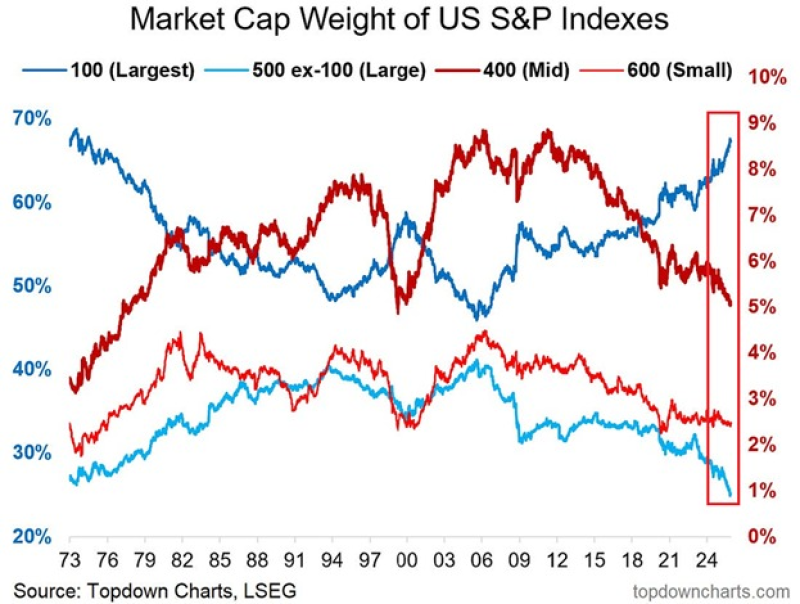
⬤ Over the past twenty years, the largest 100 companies have increased their share of the market by 23 percentage points. The remaining companies in the S&P 500 now account for only about 25 % of total market capitalization, the lowest level in at least 52 years. Mid-cap companies hold roughly 5 % of the market, down 4 percentage points over 14 years. Small-cap companies have fallen to nearly 2 %, close to their lowest levels since the Dot-Com era.
The growing performance gap between mega cap stocks and smaller companies reflects long term changes in market leadership.
⬤ This concentration signals a major shift in market dynamics. A small number of technology focused giants continue to attract capital, driven by cloud computing, artificial intelligence and large-scale platform business models. Smaller companies face higher borrowing costs and unstable earnings, which has broadened the gap over multiple years.
⬤ This situation is significant because the market now depends on a very small group of stocks. With 68 % of total value concentrated in just 100 companies, the market is more sensitive to price movements in those few names. The sharp decline in mid- and small-cap representation raises serious concerns about the sustainability of this top heavy structure and the potential consequences if those large companies experience setbacks.
 Peter Smith