Usman Salis

Microsoft's cybersecurity business generated over $37 billion in 2025, crossing 12% of total company revenue. According to Qualtrim, that figure now exceeds the combined revenues of CrowdStrike and Palo Alto Networks - a milestone that reframes how investors should think about Microsoft's business mix.
Security is no longer a supporting function inside Microsoft - it has become one of the primary growth drivers embedded across cloud and enterprise offerings.
How Microsoft's $37B Cybersecurity Business Grew Inside the Stack
Microsoft's total revenue has expanded from roughly $90 billion in 2017 to over $300 billion on a trailing twelve-month basis. That growth is distributed across three main segments: Productivity and Business Processes, Intelligent Cloud, and Personal Computing. Cybersecurity does not appear as a standalone line in Microsoft's reporting - it is woven into cloud and enterprise growth projections across multiple divisions.
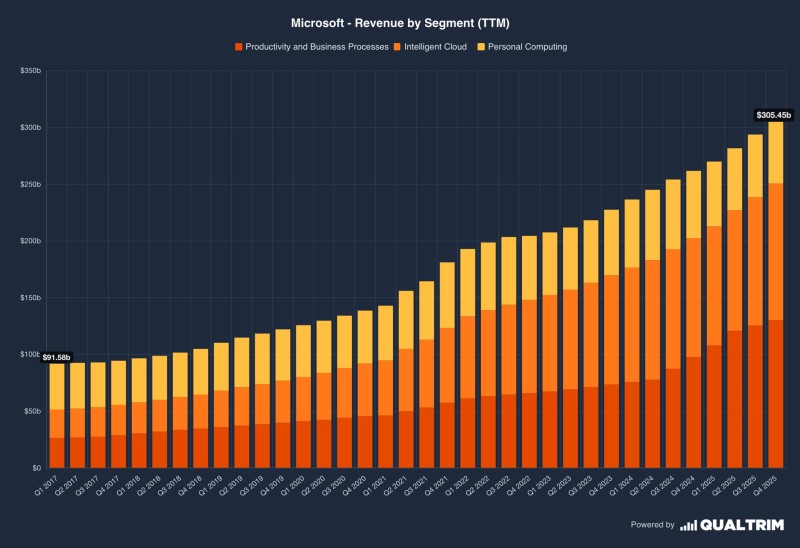
This structure makes the segment's contribution less visible at a glance, even as it quietly scaled into one of the company's largest underlying revenue streams. The growth mirrors broader dynamics in enterprise technology, where security has shifted from a standalone purchase to a default layer inside the platforms companies already run on.
At $37 billion, Microsoft's cybersecurity revenue is not just large - it is structurally embedded, meaning it grows automatically as enterprise cloud adoption expands.
Cybersecurity Scale That Rivals Entire Companies
The comparison to CrowdStrike and Palo Alto Networks combined is worth sitting with. Both are dedicated, high-growth cybersecurity businesses with strong market positions - and Microsoft's embedded security segment has surpassed both of them together. That is not a coincidence. It reflects a deliberate platform strategy where security capabilities are bundled into Microsoft 365, Azure, and Defender products that enterprises are already paying for.
Similar dynamics are visible across broader cloud expansion trends, where hyperscalers continue to scale infrastructure, software, and security in tandem. For Microsoft, that bundling approach converts IT spending decisions into compounding security revenue without requiring a separate sales motion.
The key metrics worth tracking:
- Over $37 billion in cybersecurity revenue in 2025
- More than 12% share of Microsoft's total revenue
- Exceeds the combined scale of CrowdStrike and Palo Alto Networks
- Revenue embedded across cloud, enterprise, and productivity segments
- Growth tied directly to enterprise cloud adoption rates
What the $37B Signal Means for Microsoft's Revenue Mix
Microsoft's revenue chart shows steady upward progression with no major contractions across the period shown - from the $90 billion range in 2017 to over $300 billion today. Within that trend, the cybersecurity contribution stands out not because it appears as a separate bar, but because of its size relative to the whole. A $37 billion embedded segment growing alongside cloud is a core revenue driver, not an add-on.
The steady progression in Microsoft's total revenue highlights a consistent growth trajectory - and cybersecurity is one of the clearest structural reasons that trajectory holds.
For investors, the takeaway is that Microsoft's security exposure is already significant and likely underappreciated in standard segment analysis. As enterprises continue shifting workloads to cloud and digital infrastructure, security revenue embedded in that stack will keep compounding - no separate budget line required.
 Usman Salis