Saad Ullah
⬤ Minimum wages across the EU showed major differences in January 2026 when measured in purchasing power standards per month. Germany topped the rankings at 2,157 PPS, while Estonia came in last at 886 PPS. The figures account for price level differences between countries, giving a clearer picture of what workers can actually buy rather than just looking at raw numbers.
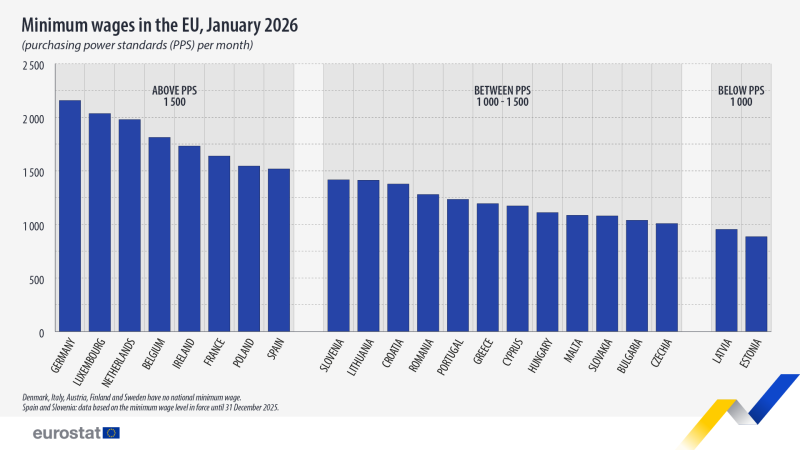
⬤ Seven countries broke through the 1,500 PPS mark. Germany, Luxembourg, and the Netherlands led the pack, with Belgium and Ireland close behind. France also made this top tier, alongside Poland and Spain, though Spain's number reflects rates that were active through the end of December 2025. These nations represent the highest earners when you factor in local living costs.
⬤ Most EU countries landed between 1,000 and 1,500 PPS. Slovenia, Lithuania, Croatia, Romania, Portugal, Greece, Cyprus, Hungary, Malta, Slovakia, Bulgaria, and Czechia all fell into this middle bracket. Latvia and Estonia dropped below 1,000 PPS, with Estonia recording the weakest minimum wage in purchasing power terms. Denmark, Italy, Austria, Finland, and Sweden don't appear in the data since they haven't set national statutory minimums.
⬤ The gap between countries matters for understanding both living standards and labor costs throughout the EU. Even when you adjust for what money actually buys in each place, the differences remain striking. As wage debates and cost-of-living pressures continue across Europe, these purchasing power comparisons give policymakers and workers a realistic view of where each country stands economically.
 Saad Ullah