Saad Ullah
⬤ During the first half of 2025, the amount that EU households pay for electricity stayed almost flat. The reason the total does not fall is that taxes now take a larger part of the bill. Eurostat's new figures show the tax share rose from 24.7 % at the end of 2024 - 27.6 % in early 2025. The headline figure hardly changed at €28.72 per 100 kWh - the underlying market price stayed still.
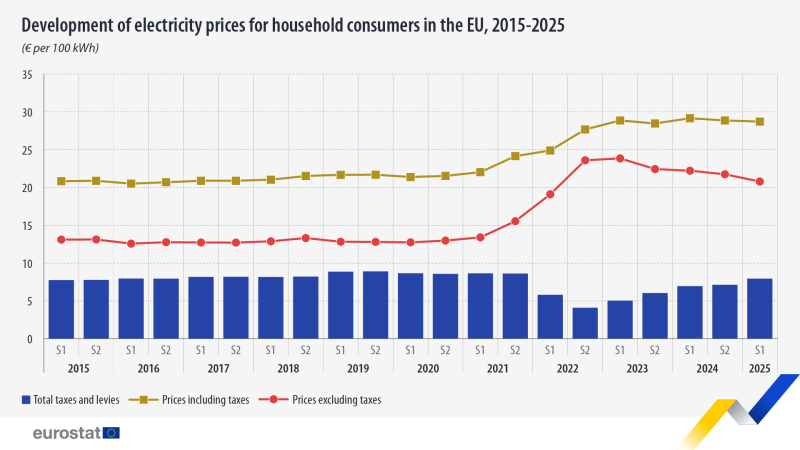
⬤ Over the last ten years the trend has been upward. In 2015 households paid about €20 per 100 kWh including taxes - today the figure is near €30. The price before tax has moved far less, but the tax portion keeps shifting. The jump to 27.6 % is one of the steepest short term changes on record.
The rise in the tax share in 2025 stands out as one of the more notable short term adjustments visible in the data series.
⬤ The tax increase reflects fresh EU energy rules, national budget needs and support schemes for renewable projects. Retail prices have not risen - governments are raising the tax share while wholesale markets stay calm. After the sharp swings of the 2022 energy crisis, both total and pre-tax prices have levelled off.
⬤ The change affects how consumers read their bills and how politicians talk about affordability. When the average price stays the same but taxes edge higher, the cost is rearranged inside the bill instead of being pushed up by raw energy prices. That shift will feed future debates on regulation, taxation and the design of the EU energy market.
 Saad Ullah