Eseandre Mordi

The relationship between economic growth and energy consumption fundamentally changed after 1971. A macro chart comparing world GDP with global oil production exposes a striking divergence that challenges traditional assumptions about how economies expand. Before the monetary link was severed, growth patterns looked completely different—but what happened after 1971 rewrote the rules.
The Great Decoupling After 1971
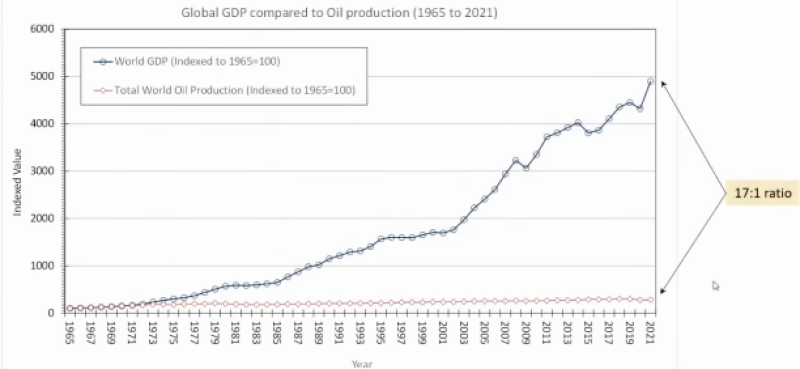
A macro chart indexed to 1965=100 shows world GDP and total oil production moving in lockstep until 1971. Once the monetary anchor was dropped, everything changed. GDP accelerated dramatically while oil production crawled forward at a much slower pace. By 2021, the gap reached roughly 17:1.
Before 1971, growth was constrained by energy availability. More output meant more oil, period. After the shift, GDP could expand through different mechanisms entirely. The chart captures this structural break perfectly—two lines that once tracked together now tell completely different stories.
Western Financialization vs. Chinese Industrialization
The post-1971 era brought financialization to Western economies. Manufacturing declined as services and finance took over. Energy-intensive production moved offshore. Credit, leverage, and asset turnover became the primary GDP drivers rather than physical output.
Meanwhile, China industrialized. The country absorbed manufacturing, built factories and infrastructure, and increased energy consumption alongside GDP growth.
The 2000 Derivatives Shift
The year 2000 added another layer. When derivatives were included in GDP accounting, the distortion amplified further. Financial turnover inflated GDP numbers without corresponding increases in energy use or physical output. The divergence widened even more.
This chart-based analysis reveals a structural transformation in how economic growth relates to resources and how output gets measured across different systems. GDP became increasingly credit and accounting-driven in some economies while remaining physically grounded in others.
 Eseandre Mordi