Eseandre Mordi
Electricity is now being represented on-chain through the XRP Ledger, as JMWH tokens - each tied to one megawatt-hour of energy - reach a total value of $861 million. The data points to an operational system already tracking real contracts and consumption, rather than a conceptual pilot.
From Electricity to XRP Ledger On-Chain Units
As X Finance Bull noted, JMWH is a digital asset directly linked to electricity production. Each token represents 1 MWh and is backed by real-world energy contracts in Latin America.
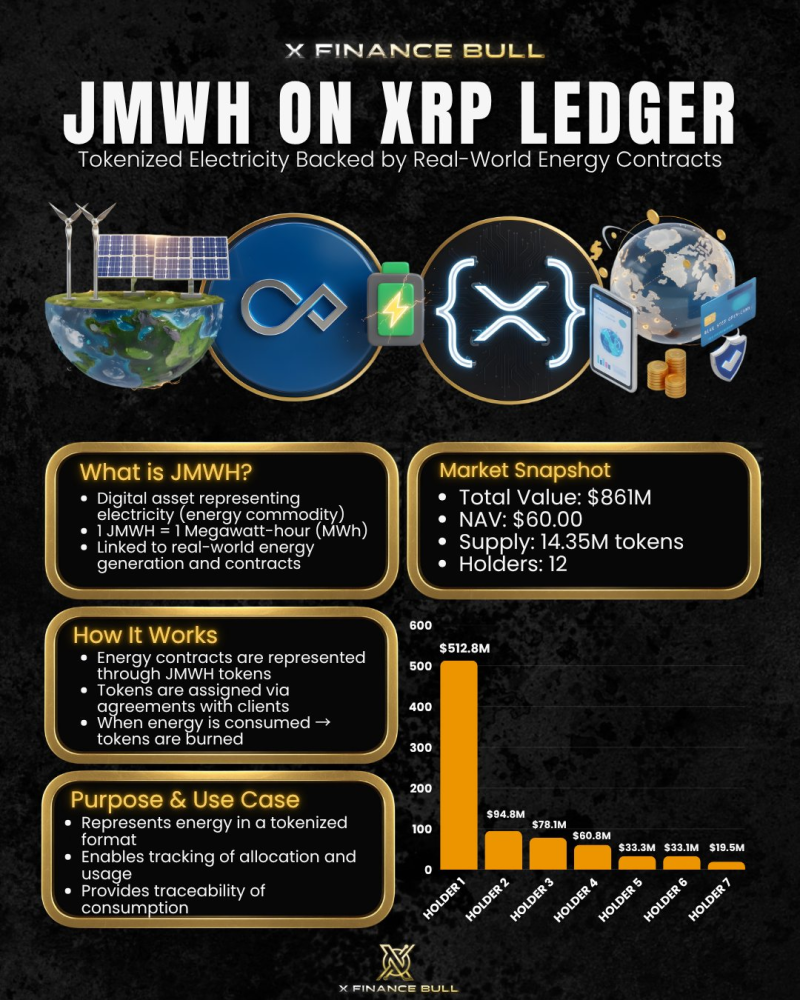
The mechanism reflects a closed-loop structure. Energy contracts are tokenized into JMWH units, assigned to clients through agreements, and burned once the electricity is consumed. This ensures that token supply mirrors actual usage and keeps on-chain records aligned with real-world activity.
Token supply mirrors actual usage - tokens are issued against real contracts, allocated to clients, and burned once the electricity is consumed, creating a direct linkage between physical infrastructure and on-chain accounting.
Concentrated Structure Revealed by the JMWH Chart
The chart shows a highly uneven distribution across holders. One wallet accounts for over $500 million, while the remaining participants hold significantly smaller allocations. With only 12 holders in total, the structure indicates a tightly controlled market at this stage - consistent with early institutional or contract-based allocation rather than open market circulation.
The sharp drop from the largest holder to others suggests limited distribution, which is typical of systems in early operational phases before broader market access is introduced.
XRPL Expands Its Tokenized Asset Role Into Energy
The XRP Ledger is increasingly being used beyond payments, with multiple real-world asset initiatives already moving on-chain. XRP Ledger Gains Traction as Firms Tokenize $372M in Private Credit showed how institutional players have been issuing hundreds of millions in tokenized instruments on XRPL - and the JMWH system extends that pattern into an entirely new asset class.
The XRP Ledger is increasingly being used to anchor tangible assets, moving beyond payments into real-world value representation across private credit, energy, and financial instruments.
Mercado Bitcoin to Bring $200M in Real-World Assets to XRP Ledger reinforces how Latin America specifically is emerging as an active region for XRPL-based tokenization - making the geography of the JMWH energy contracts a natural fit for the ledger's growing regional footprint.
A Live XRPL System With Real Allocation and Burn Mechanics
The $861 million total value combined with active token issuance and burn mechanics signals a functioning system already tied to real consumption - not a proof of concept. The supply dynamically reflects real-world usage, creating a model where blockchain settlement and physical infrastructure are directly connected.
$10T XRPL Flow Talk Triggers $179 Price Math Debate places this kind of real-world asset growth within the broader conversation about what expanding XRPL utility means for XRP itself - a debate that becomes more grounded with each operational system like JMWH that moves from concept to live settlement.
Ownership remains concentrated for now, but the presence of real contracts and measurable supply dynamics signals a structural shift. The XRP Ledger is moving beyond the idea of tokenization and into the practice of it.
 Eseandre Mordi