Alex Dudov

Dogecoin is trading near $0.094 again - a level most long-term holders know all too well. DOGE has re-entered what analysts call the "Depression Zone," a historically weak accumulation range that tends to drag on far longer than most investors expect. With the broader altcoin market still recovering from multi-year highs, the timing of this return raises a familiar question: how long before the next real move?
DOGE Near $0.09 Support: What the Weekly Chart Shows
The weekly chart tells a straightforward story. After peaking well above $0.40-$0.50 in the previous cycle, Dogecoin has steadily unwound back into a compressed range where DOGE is printing lower highs near $0.095, with support around $0.09 and resistance capping upside near $0.10. The structure is tight, low-energy, and very consistent with how the Depression Zone has looked in prior cycles. There is no panic selling - just a slow grind with little directional conviction from either side.
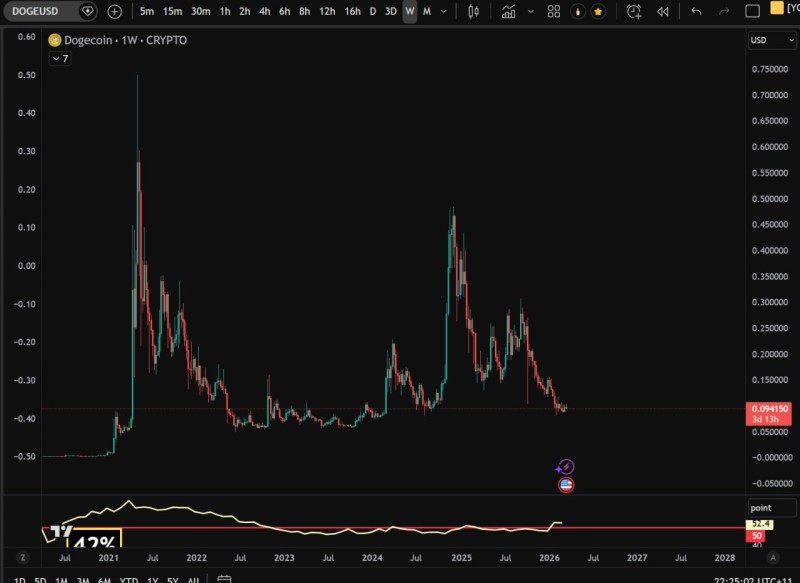
Historical cycle data adds weight to that picture. The last time Dogecoin entered a comparable low-sentiment range, it spent roughly 2.5 years consolidating before flipping into a new expansion phase. If the pattern holds, the Dogecoin chart may not point to a meaningful reversal until late 2027 or even 2028.
3 Mini Cycles Within the Range - and What Could Follow
Despite the gloomy label, the Depression Zone is not a dead zone. Analysts tracking shorter timeframes have noted that 3 mini cycles within the current range hint at a possible Dogecoin rally developing from inside the consolidation. These smaller rotations suggest that accumulation is happening gradually, even if the macro trend has not yet confirmed a shift. Price behavior within the $0.09 to $0.10 band will likely be the first signal of whether a new cycle is quietly building or whether the range extends further.
The broader takeaway is consistent with how crypto cycles have historically worked: major peaks are followed by extended drawdowns, then prolonged sideways action, then expansion. Dogecoin appears to be in the middle phase right now. The Depression Zone is not a place where prices move fast, but it is often where the next big cycle quietly begins.
 Alex Dudov