
 Marina Lyubimova

⬤ Gold is making another attempt to break higher after consolidating for several weeks, now pushing toward the $4,250 level. Precious metals have been showing coordinated strength lately, and history shows that when this sector heats up, the initial breakouts usually move fast. The metal previously spent four months building an ascending triangle that broke out at $3,450, then rallied all the way to $4,380. Since that peak, gold has been trading in a tightening range with support holding around $3,886 and resistance sitting between $4,250 and $4,380.
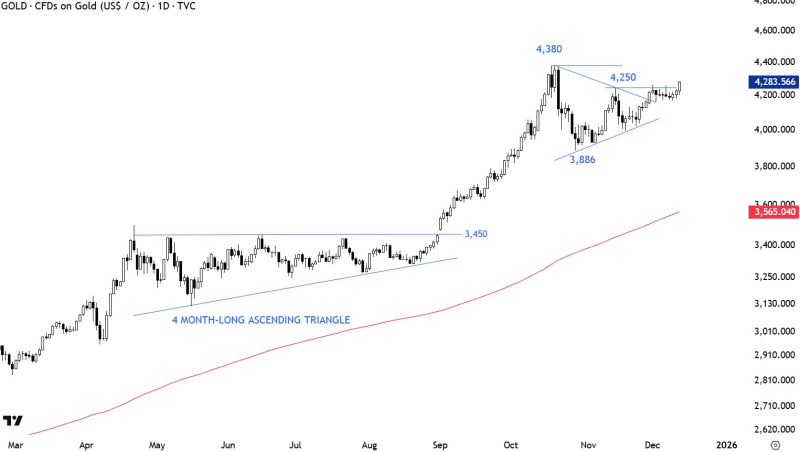
⬤ Right now, the price action is forming higher lows inside a short-term ascending pattern. Gold recently pushed back above the upper boundary of this formation, showing that buyers are stepping in again as it aims for that $4,380 high. The broader uptrend still looks intact, backed by rising moving averages and steady demand across precious metals. Silver broke out earlier, which often signals that gold is next in line to make its move.
In any strengthening sector, early breakouts often lead the move—gold's tightening structure is following this playbook.
⬤ The current setup looks similar to what happened before gold accelerated out of its previous consolidation. When ascending triangles resolve after months of sideways action, the follow-through can be sharp. That's exactly what happened at $3,450, and the market is watching to see if the current squeeze produces the same result. Gold's behavior fits the pattern where laggards eventually catch up once sector momentum takes hold.
⬤ This matters because gold's price is tied to bigger macro forces—central bank policy, risk appetite, and commodity trends overall. A clean break above $4,250 to $4,380 would confirm the uptrend is back on and signal fresh demand across the entire precious metals space. With silver already moving and gold tightening near resistance, this could be the setup that determines whether the sector's strength continues or stalls out.
 Marina Lyubimova



