Eseandre Mordi

⬤ Gold made history on December 18 when COMEX February 2026 futures pushed past $4,400 for the first time on record. The precious metal settled near this psychological barrier after a steady climb that kicked off back in late September. What started around $3,700 has turned into one of the most impressive rallies in recent memory.
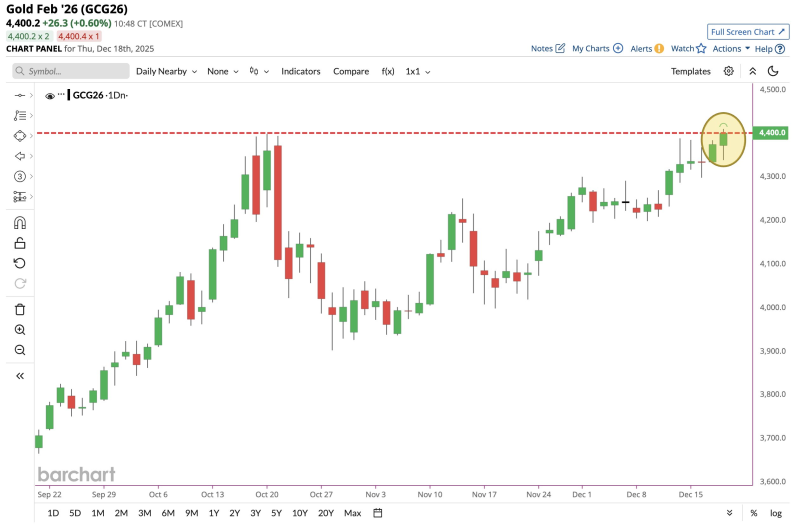
⬤ Looking at the daily charts, the pattern couldn't be clearer—higher highs and higher lows stacking up month after month. From those September lows near $3,700, gold powered through $4,300 in early December before finally cracking the $4,400 level. The interesting thing? Prices aren't getting rejected at these heights. Instead, we're seeing consolidation, which suggests traders are comfortable buying at these elevated levels.
The sustained move above $4,400 represents more than just a number—it's a shift in how markets are viewing long-term stability and risk.
⬤ Breaking through $4,400 wasn't just about momentum—it was about overcoming real resistance that had held prices back earlier in the rally. What's caught traders' attention is how shallow the pullbacks have been. Every time gold dipped during November and December, buyers jumped right back in. Even better, when prices retested those old resistance zones below $4,300, they held firm, proving the uptrend has real legs.
⬤ This record isn't happening in a vacuum. Gold has always been a go-to indicator when markets get nervous about macro conditions, and right now it's flashing some serious signals. If $4,400 becomes the new floor rather than just a spike, we could see ripple effects across precious metals and beyond. The big question now: can gold keep pushing higher, or are we due for a breather after this historic run?
 Eseandre Mordi