Saad Ullah

Tesla's stock is sitting at one of the most watched technical junctions in months. With price locked between a short-term descending channel and long-term bullish support, TSLA is setting up for a move that could define its near-term direction. Traders are paying close attention as three major support structures converge around the $399 level.
Three Converging Supports Put $399 in the Spotlight
TSLA is trading directly at the November lows, the base of a long-term ascending channel, and its 50-week moving average simultaneously. This triple confluence around $399 makes the current zone a high-stakes decision point. On the daily chart, the stock is carving lower highs while defending horizontal support, a pattern that compresses price action and typically precedes a sharp expansion in volatility.
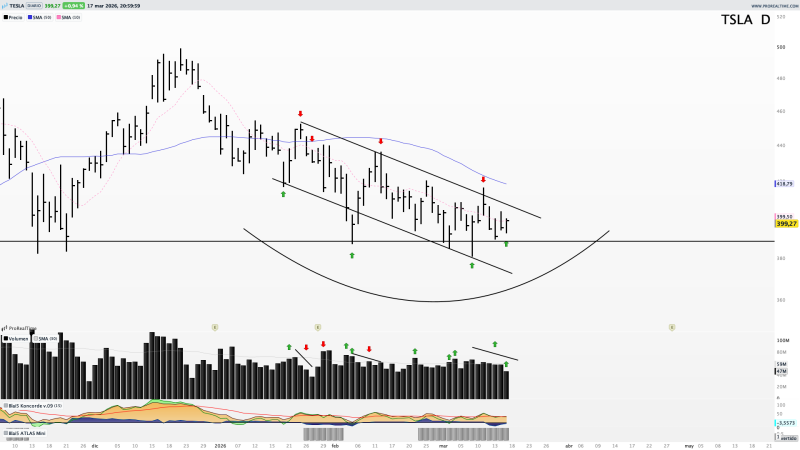
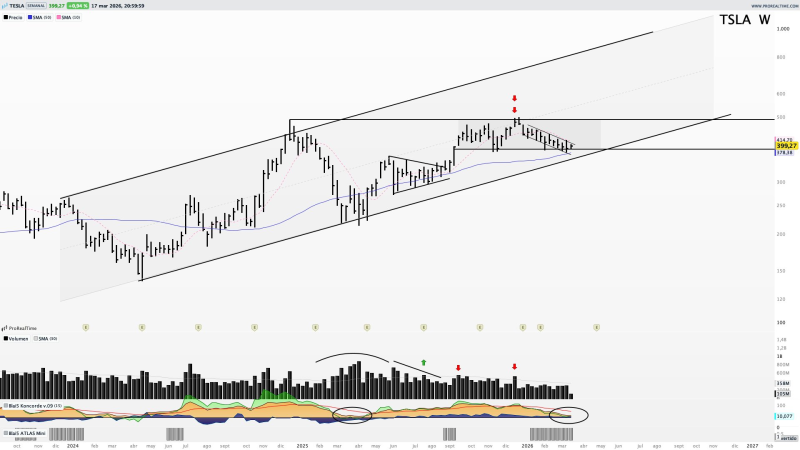
The weekly chart, meanwhile, confirms the stock remains within a broader upward structure, framing the recent pullback as corrective rather than trend-reversing. TSLA Holds $395 Support as Bollinger Bands Tighten Near $291-$499 Range offers additional context on how the squeeze is developing across timeframes.
Accumulation Pattern Reinforces the $387-$400 Support Pivot
The $387 to $400 range has emerged as a recurring reaction zone on the weekly chart, where buyers have consistently stepped in to absorb selling pressure. Price consolidation within this band points to accumulation rather than distribution, which historically precedes a move to the upside once resistance gives way. That said, TSLA remains in a corrective structure below the $418 level, which continues to act as a ceiling for any recovery attempt. A detailed breakdown of this resistance dynamic is covered in TSLA Stock Stays in Correction Below $418.86 Resistance. For the bigger picture, TSLA Consolidates Between $383 Support and $440 Resistance Shelf maps out the full range that has kept the stock contained in recent weeks.
With multiple key levels stacking up in the same zone, the setup is unusually well-defined. The longer price stays compressed between these boundaries, the more energy builds behind the eventual move. Whether that move is a breakout or a breakdown, the current structure leaves little room for ambiguity once a clear directional bias emerges.
 Saad Ullah