Usman Salis

⬤ Tesla just dropped a new patent that could be a game-changer for its 4680 battery cells. Published on December 4, 2025, the filing dives into how Tesla plans to make silicon composite anode materials using dry electrode processes—a technology the company's been betting big on for its next-generation batteries.
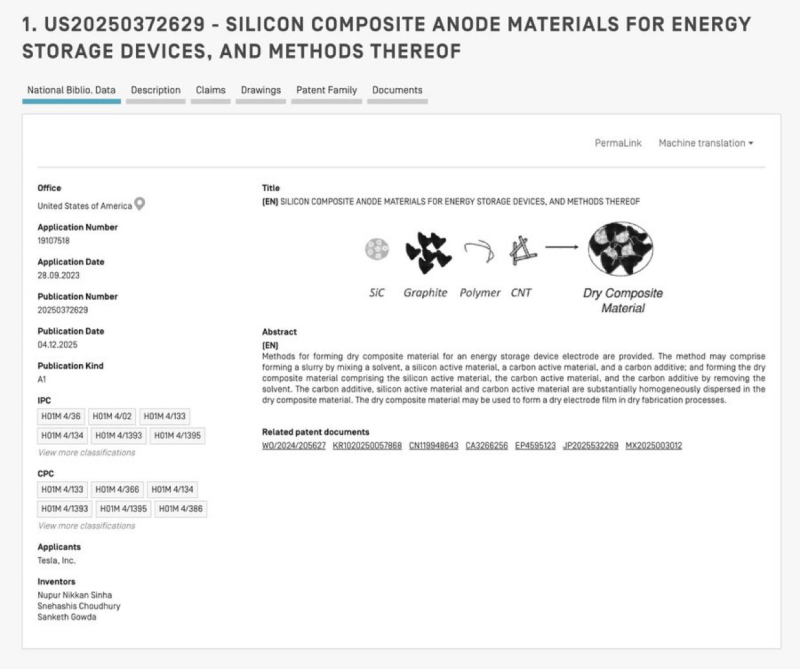
⬤ Here's what makes this interesting: silicon anodes can store way more energy than traditional graphite, but they've always been tricky to work with. They expand and contract during charging cycles, which can damage the battery. Tesla's patent tackles this head-on by outlining a method that mixes silicon with carbon materials and additives, then removes solvents to create a stable, dry electrode material. The key is getting everything evenly distributed throughout the composite—something that's easier said than done.
⬤ The technical breakdown shows Tesla's using a mix of silicon carbide, graphite, polymers, and carbon nanotubes in the anode structure. The patent illustrations lay out how these materials come together in a dry composite designed specifically for energy storage. What's notable here is that this approach could allow Tesla to pack more silicon into its batteries without sacrificing durability—something that's been a major hurdle in battery development.
⬤ Because dry electrode manufacturing is faster, cheaper, and more environmentally friendly than traditional wet processes. If Tesla can successfully scale silicon-rich anodes with this technology, it could mean longer-range EVs built at lower costs. While the patent doesn't guarantee immediate production changes, it shows Tesla's continuing to push battery technology forward—and that's something the entire EV industry is watching closely.
 Usman Salis