Peter Smith

⬤ Americans are pulling back on holiday spending in a big way. New survey data reveals that consumers now expect to spend just $778 on gifts this season—down $229 from what they planned in October. According to Gallup, this represents the sharpest October-to-November decline since they started tracking this metric in 2006.
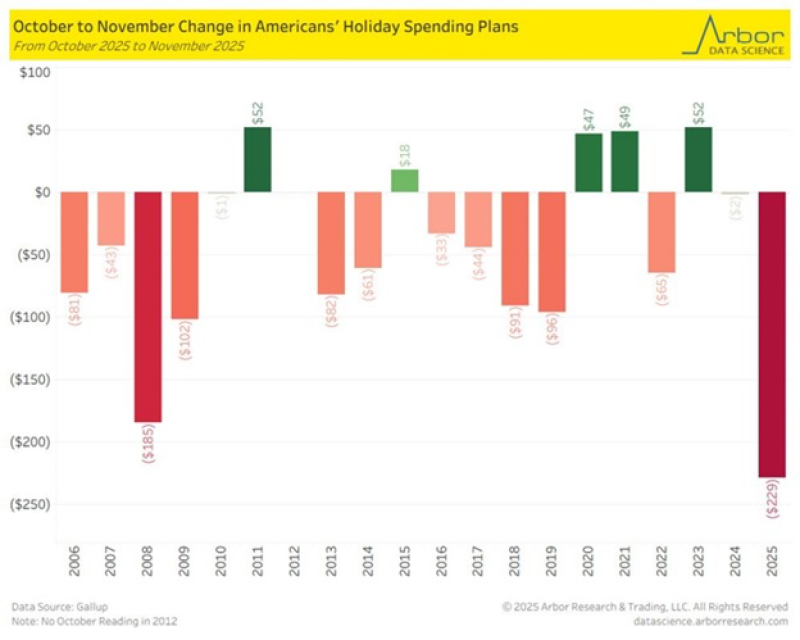
⬤ The numbers tell a stark story when you compare them year-over-year. This November's spending expectations sit $234 below last year's $1,012 figure, showing just how much consumer confidence has eroded. What's really striking is that this drop actually exceeds what we saw during the 2008 financial crisis, when spending expectations fell by $185. That puts today's reading among the weakest we've seen in nearly two decades.
This is the largest October to November decline in expected holiday spending since the survey began in 2006.
⬤ It's not just one segment feeling the pinch—this pullback cuts across all income levels. Both wealthy and lower-income Americans are planning to spend less compared to what they expected just a month ago. The data shows that financial pressures aren't discriminating, and households across the board are tightening their belts heading into the holidays.
⬤ For markets, this matters quite a bit. Consumer spending drives a huge chunk of economic activity and corporate earnings, especially during the crucial holiday season. When people dramatically cut their spending plans, it ripples through retail performance and investor sentiment around major benchmarks like the S&P 500. With inflation still eating away at purchasing power, these shifts in consumer behavior are becoming one of the most important signals for understanding where the economy—and markets—might be headed next.
 Peter Smith