Usman Salis

Germany's tourism industry just set a new benchmark. The country welcomed 497.5 million overnight stays in 2025, marking the highest figure on record. While domestic travelers drove most of the growth, the picture tells an interesting story about how international tourism behaves after major events.
Germany Records 497.5 Million Overnight Stays
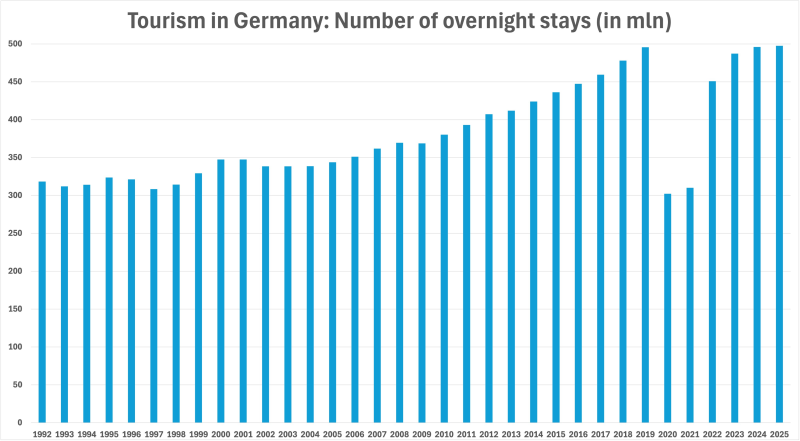
Germany tourism data hit a fresh peak in 2025, with total overnight stays reaching 497.5 million. The growth came mostly from locals: domestic overnight stays climbed 0.7% year over year to 413.7 million. Foreign visitor stays, however, fell 1.8% to 83.8 million. That decline followed a particularly strong 2024, when Germany hosted the European Football Championship in June and July, bringing in extra international visitors.
Domestic Travel Fuels 2025 Tourism Growth
Looking at the numbers over time, Germany's tourism chart shows a steady rise from the early 1990s. There was a sharp drop around 2020, then a gradual recovery through 2022 and 2023. The rebound picked up speed in 2024 and continued into 2025's record. The data suggests this isn't just a temporary spike - it's part of a broader recovery after the pandemic disruption.
The mix of visitors shifted in 2025. Foreign stays made up 16.8% of the total, down from 17.2% the year before. As Holger Zschaepitz reported, that means Germany's tourism growth last year was anchored almost entirely by domestic travel, while international flows proved more sensitive to one-time events.
The 2025 record indicates demand resilience, while the softer foreign share highlights how international flows can normalize quickly once major events pass.
What This Means for Germany's Economy
For anyone watching DAX Germany macro conditions, tourism overnight stays offer a real-time snapshot of service activity and consumer movement. The 2025 record shows demand is holding up well. At the same time, the drop in foreign visitors shows how quickly international arrivals can cool off once big events like the football championship are over. That shift matters for travel-related revenues and the broader momentum in Germany's services sector.
 Usman Salis