Eseandre Mordi
⬤ In 2024 the European Union used 900 million tonnes of oil equivalent of final energy, 0.7 % more than in 2023. Eurostat states that the Union now lies even farther from its 2030 ceiling of 763 Mtoe. The distance between the real figure and the ceiling has stayed wide plus shows no clear sign of shrinking.
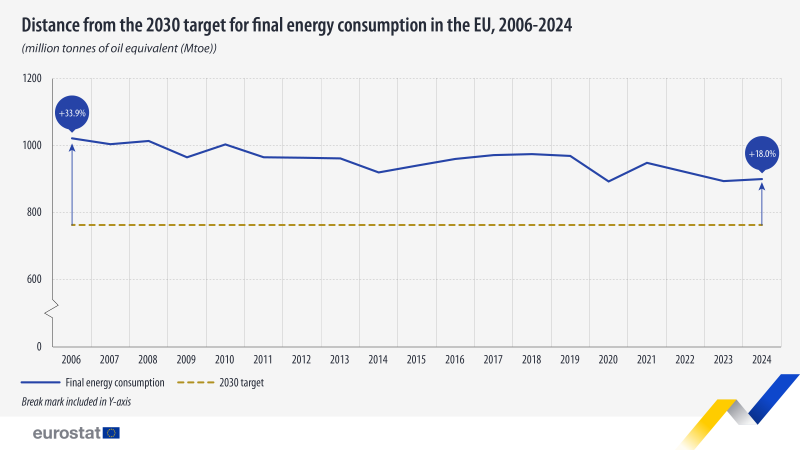
⬤ Last year's demand exceeded the ceiling by 18.0 %, against 17.2 % in 2023. Over the last two decades the figure has moved up and down - yet it has never dropped to the required level. The small dip recorded in 2023 did not continue - the 2024 result confirms that the Union still takes more energy than foreseen.
The EU's energy demand has surpassed the ceiling year after year but also the surplus has barely narrowed in the latest period.
⬤ Seen over the longer term, demand peaked in the mid-2000s, fell sharply after the 2008 financial crisis then flattened. The minor rise in 2024 hints that advance toward efficiency goals may be slowing.
⬤ High demand touches the Union's climate pledges and its sustainability path. If those levels persist, they will steer later policy choices, climate plan revisions as well as infrastructure spending. To reach the 2030 ceiling and to keep the long term route, the Union must revise its efficiency strategy.
 Eseandre Mordi