Saad Ullah

⬤ Job losses among college-educated workers have hit an unprecedented level, marking a significant change in how the U.S. labor market operates. People with four-year college degrees now make up 25.3% of all unemployed Americans—the highest share ever recorded since tracking began in 1992. Data from the U.S. Department of Labor and Bloomberg shows this isn't just a spike, but part of a long-term upward trend that's picked up serious speed recently.
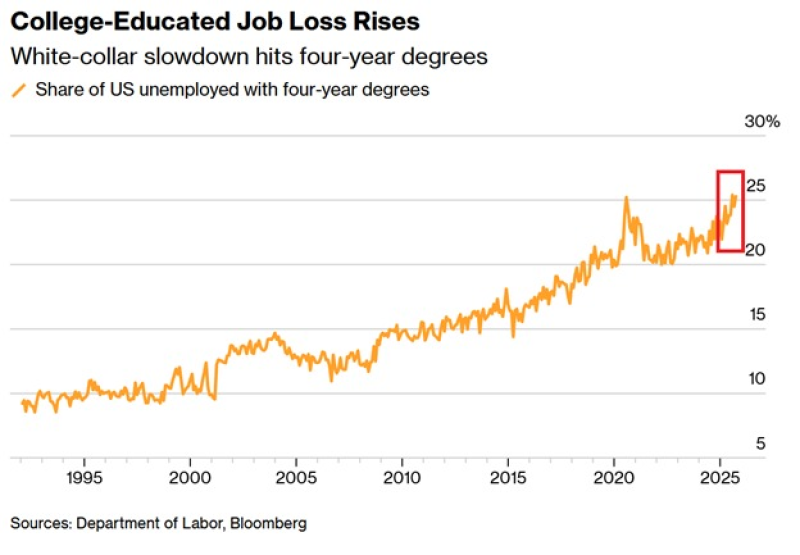
⬤ The numbers tell a striking story: the proportion of unemployed workers with four-year degrees has essentially doubled since 2008. Right now, more than 1.9 million college-educated Americans aged 25 and older don't have jobs. What used to be a relatively stable and low unemployment rate for degree holders has been climbing steadily for over a decade, breaking into record territory. This looks less like a temporary hiccup and more like a fundamental shift in how the job market works.
⬤ The pressure's clearly moved from blue-collar industries to white-collar jobs. Tech companies, professional services, finance firms, and corporate offices have been cutting staff, freezing hiring, and restructuring operations. The steady climb that started in the mid-2010s has gotten noticeably steeper heading into 2025, pointing to real weakness in sectors that used to feel pretty secure during economic rough patches.
⬤ This shift matters beyond just employment statistics. When more college graduates are out of work, it affects wage growth, how much people spend, and overall economic confidence. Degree holders typically earn more and spend more, so higher unemployment in this group can ripple through the economy in unexpected ways. With this metric now at its all-time high, it's becoming clear the U.S. labor market isn't just going through a brief slowdown—it's experiencing a meaningful transformation that could stick around.
 Saad Ullah