Usman Salis

The U.S. entry-level job market is showing troubling signs as fresh graduates face the toughest compensation landscape since 2019. Real wages have plummeted from pandemic-era highs, and fewer young professionals are landing jobs that match their education—a double squeeze that's reshaping early-career prospects across the country.
Graduate Starting Salaries Drop to $54.5K Amid Cooling Market
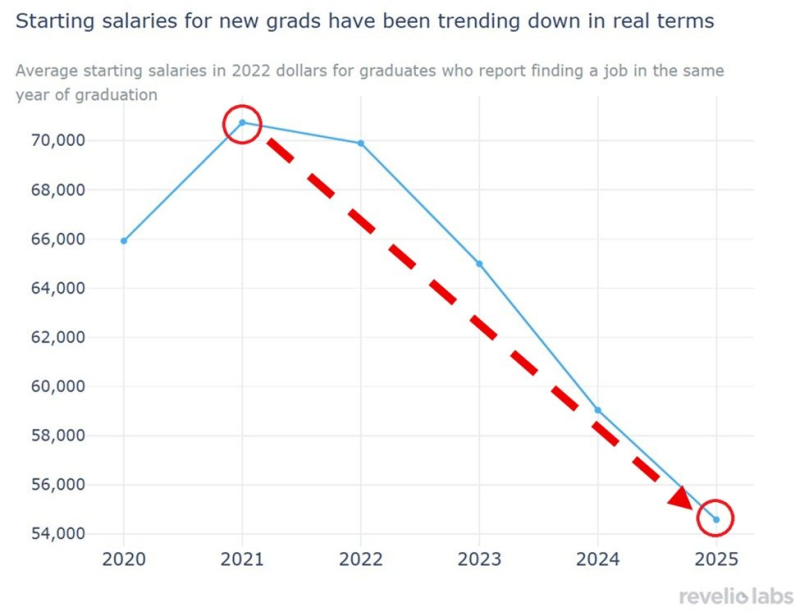
Entry-level labor market conditions in the U.S. continue losing steam. According to The Kobeissi Letter, the inflation-adjusted average starting salary for college graduates has dropped to roughly $54,500—an 8% year-over-year decline and the weakest reading in at least six years.
More graduates are accepting lower-paying positions unrelated to their degree, the report notes, highlighting how talent is being pushed into mismatched roles.
The data reveals a steep slide from the 2021 peak near $71,000. In real terms, starting salaries have fallen about 24% since that high, marking four straight years of decreases. This downturn reflects weaker early-career compensation compared with the post-pandemic expansion period and mirrors broader labor market weakness.
Job Alignment Hits New Low as Degree-Related Roles Vanish
Beyond falling wages, job matching conditions have also deteriorated sharply. The share of graduates working in roles aligned with their field dropped from 26% for the 2022 cohort to just 20% for the 2025 cohort. More new workers are settling for positions outside their area of study—often at reduced pay—reinforcing the real wage decline and echoing concerns around permanent job losses.
What This Means for the Entry-Level Job Market
The numbers paint a clear picture: entry-level employment conditions are contracting, not expanding. Falling real wages combined with reduced job alignment signal a shift away from the tight labor environment of recent years. For graduates entering the workforce now, the landscape looks fundamentally different—and tougher—than it did just three years ago.
 Usman Salis