Marina Lyubimova
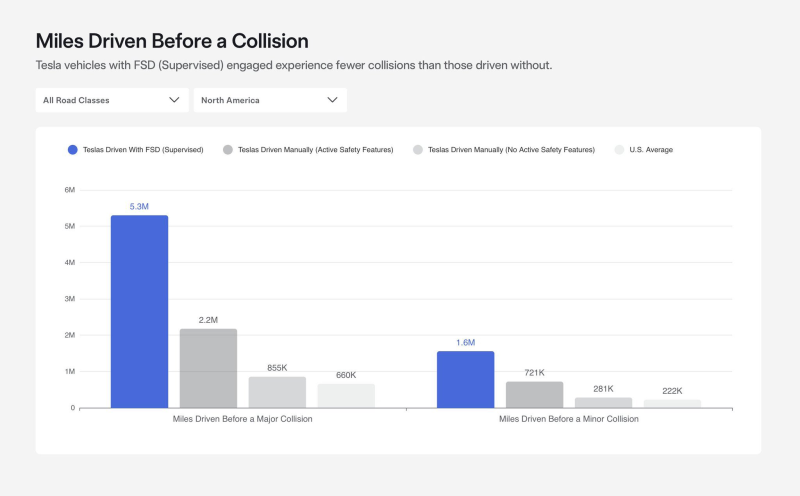
⬤ Tesla just dropped fresh numbers on Full Self-Driving usage that are turning heads. Tesla owners have now racked up over 8 billion miles on FSD (Supervised) - a huge milestone that's creeping closer to the roughly 10 billion miles Elon Musk once flagged as the sweet spot for safe unsupervised self-driving. The company also released a safety chart titled "Miles Driven Before a Collision" covering North American roads, and the data shows Teslas running FSD (Supervised) are getting into fewer accidents than those driven manually.
⬤ The numbers tell an interesting story. For major collisions, FSD (Supervised) vehicles go an average of 5.3 million miles before a crash. Compare that to 2.2 million miles for Teslas driven manually with active safety features, 855,000 miles with no safety features, and just 660,000 miles for the average U.S. driver. Minor collisions follow a similar pattern - FSD (Supervised) logs 1.6 million miles between incidents, while manual driving with safety features hits 721,000 miles, manual without features drops to 281,000, and the national average sits at 222,000 miles.
⬤ This update feeds into the bigger conversation around how Tesla (TSLA) is positioning its autonomy progress through real-world data. The discussion around FSD adoption has been heating up, including debates about Tesla's 2025.44 Update FSD adoption rate, analyst coverage of Stifel's $508 price target based on FSD and Robotaxi momentum, and speculation about TSLA Robotaxi breakthrough potential.
⬤ Why does this matter? Tesla's autonomy story now has two concrete data points investors and analysts can track: the growing pile of supervised FSD miles and comparative safety stats showing longer intervals between crashes. As the FSD fleet keeps logging miles, these metrics will likely stay front and center in conversations about where Tesla's self-driving tech is actually headed.
 Marina Lyubimova