Marina Lyubimova

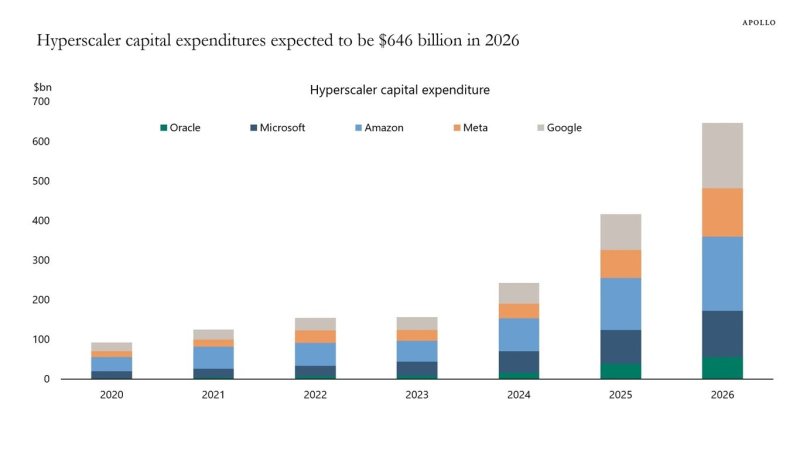
The numbers coming out of Wall Street on big tech infrastructure spending are hard to ignore. An estimate from Apollo's Torsten Slok puts combined hyperscaler capex at approximately $646 billion for 2026. To put that in perspective, that's roughly equivalent to 2% of the entire U.S. gross domestic product - a single year of infrastructure investment from a handful of tech companies matching the economic output of a mid-sized country.
$646B Hyperscaler Capex: What the Numbers Actually Show
The chart tracking hyperscaler capital spending from 2020 to 2026 tells a clean story: slow build, then liftoff. In the early 2020s, annual outlays were measured in the tens of billions. By 2024 they had climbed into the low hundreds of billions. Then 2025 pushed further, and 2026 is forecast to blow past all prior records. Microsoft MSFT and Amazon AMZN lead the pack as the biggest spenders, with Google GOOGL and Meta putting up substantial numbers of their own. Even Oracle, smaller by comparison, shows steady growth as the overall pool expands. The direction is unmistakable - hyperscalers are not slowing down.
AI and Cloud Demand Are Driving the Surge
The spending explosion is not happening in a vacuum. Demand for AI compute, data center capacity, and cloud services has created a kind of arms race among the largest tech players. GPUs, servers, networking gear, real estate for data centers - all of it is being bought at scale. $715B AI Spending Surge Won't Boost Economy, JPMorgan Warns examines how this wave of investment, despite its size, may not translate into broader economic gains the way traditional infrastructure spending would. That tension - massive capex with uncertain macro payoff - sits at the center of current analyst debate.
On the equity side, the capex surge has direct implications for chipmakers and hardware suppliers. NVDA Stock: Capex Surge Fuels AI Growth breaks down how hyperscaler spending cycles feed directly into Nvidia's revenue pipeline and broader semiconductor demand.
At $646 billion, hyperscaler capex in 2026 is not just a technology story - it is a macroeconomic one. When a cluster of companies spends an amount equal to 2% of U.S. GDP in a single year, it reshapes supply chains, labor markets, and energy grids. The scale of this investment cycle reflects how central cloud and AI infrastructure has become to the global economy, and how far hyperscalers are willing to go to stay ahead of the curve.
 Marina Lyubimova