Eseandre Mordi
⬤ Elon Musk thinks we're about to see AI become the main force pushing the US economy forward. He's predicting the country could hit double-digit GDP growth within the next year to year and a half, jumping up from today's roughly 4.3 percent baseline. If AI keeps spreading and actually delivers on its productivity promise, Musk says we could be looking at triple-digit economic expansion over the next five years.
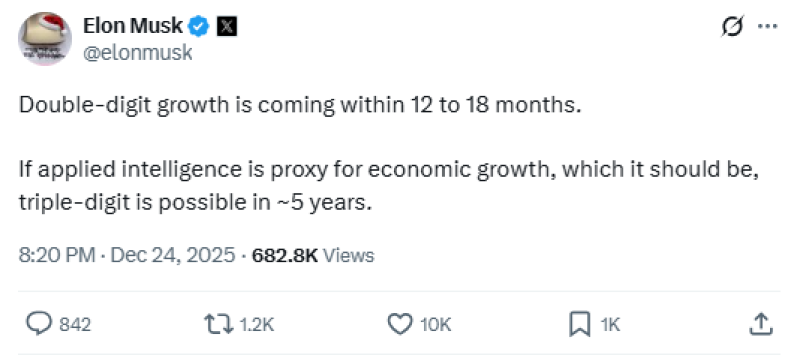
⬤ The idea is pretty straightforward: as companies roll out AI tools that automate tasks, cut costs, and boost efficiency, they need fewer people to do the same amount of work. That frees up cash that can go toward growth and hiring elsewhere. Musk's betting this cycle could push GDP growth past 10 percent once AI moves beyond the early-adopter phase and becomes standard across industries.
⬤ If this plays out, the investment side could get really interesting. Companies making chips, running cloud services, building data centers, and powering infrastructure would likely see serious demand. At the same time, businesses using AI could pump out higher revenue with better margins, which typically means stronger earnings and potentially higher stock prices if investors believe the growth can last.
⬤ That said, there are real risks here. AI adoption could slow down, energy limitations might cap how fast it scales, or new regulations could throw up roadblocks. If any of that happens, the whole timeline gets pushed back. That's why watching actual enterprise spending on AI and tracking real productivity gains matters so much right now. For companies like Tesla that are betting big on AI and automation, how this all unfolds will shape not just their future but the broader economic picture.
 Eseandre Mordi